
Explore the Buffer Solution Simulator
Add acid and base to a buffer and to plain water side by side and watch which one resists pH change. Free, no signup, runs in your browser.
- Free to use
- No signup
- Nothing to install
- Runs in your browser
Illustration. Open the tool for the real thing.
See it in action
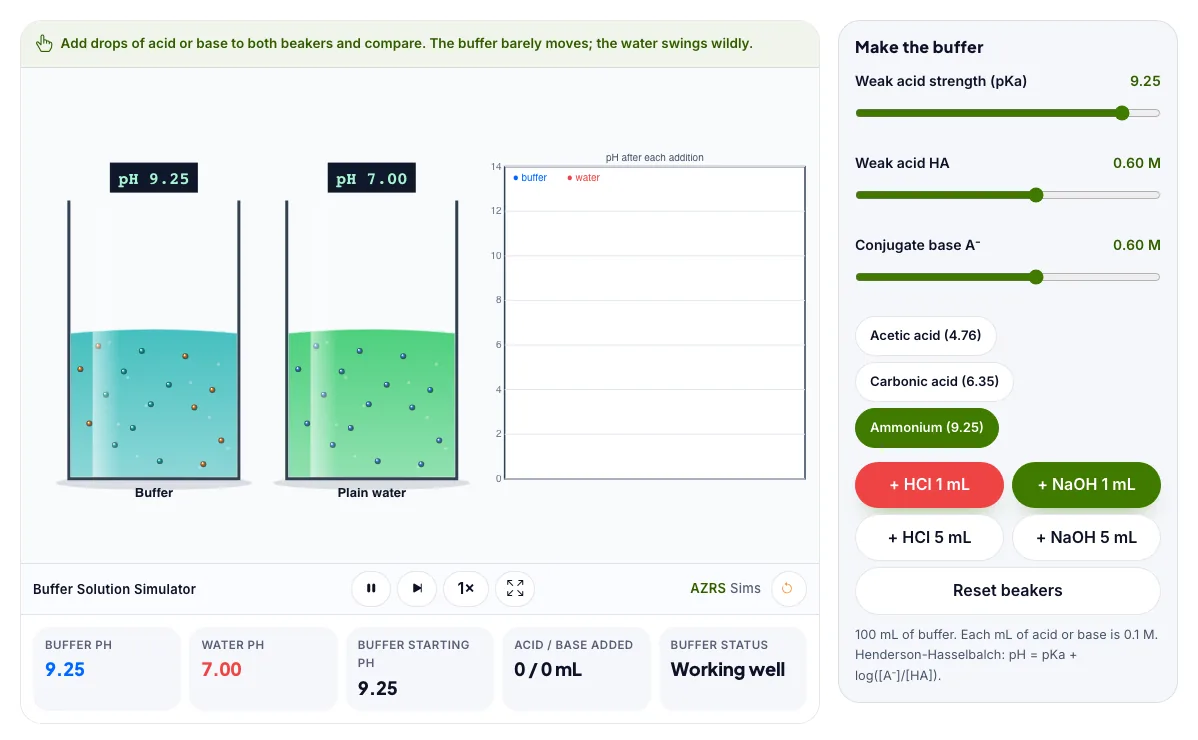
The Buffer Solution Simulator with sample data entered and the result showing.
What is the Buffer Solution Simulator?
Add acid and base to a buffer and to plain water side by side and watch which one resists pH change. It runs in your browser, so a change to a setting or a drag on an object shows up at once.
Blood, seawater, shampoo, medicines and food all use buffers to keep pH steady. Your blood pH must stay near 7.4 and is kept there mostly by the bicarbonate buffer.
3 steps to your result
Open the tool and follow along. Nothing to install.
What you get
A buffer contains a weak acid (HA) and its conjugate base (A⁻) that neutralise added acid or base.
Henderson-Hasselbalch: pH = pKa + log([A⁻] / [HA]).
A buffer works best when [A⁻] ≈ [HA] and has a limited capacity.
Add 10 drops of HCl to the buffer and to water and compare.
Increase both concentrations to raise the buffer capacity.
Set [A⁻] = [HA] and read the pH: it equals the pKa.
Used for
Pick one to see how it fits.
Chemistry learners
Chemistry students from middle school to university, teachers who need a virtual demonstration, and anyone without access to a lab.
Try it freeTeachers
For teachers: project the Buffer Solution Simulator on the board, let students predict the result, then run it together and test this: Increase both concentrations to raise the buffer capacity. For students: change one thing at a time and write down what changes.
Try it freeHow it compares
A plain look at this tool next to the usual alternative.
| This simulation | Textbook diagram | |
|---|---|---|
| Interactive | Drag, tap and change settings | Fixed picture |
| Install | Nothing to install | Not needed |
| Cost | Free to use | Depends on the book |
Questions people ask
How does a buffer resist pH change?
Added acid reacts with the conjugate base A⁻, and added base reacts with the weak acid HA. Both reactions use up the added ion instead of letting the pH swing.
When does a buffer stop working?
When one of the two components has been used up. Then extra acid or base changes the pH just as in plain water.
Is the Buffer Solution Simulator free to use?
Yes. The Buffer Solution Simulator is free, needs no signup or download and runs in your web browser. It is part of the Chemistry group of AZRS simulations.
Does the Buffer Solution Simulator work on a phone or tablet?
Yes. The Buffer Solution Simulator takes touch input as well as mouse input, so you can use its 3 adjustable settings with a finger. A larger screen makes the controls and graphs easier to read.
How do I use the Buffer Solution Simulator?
1. In the Buffer Solution Simulator, use the controls to change Weak acid strength (pKa), Weak acid HA, Conjugate base A⁻. The simulation reacts instantly. 2. In the Buffer Solution Simulator, pick an option such as Acetic acid (4.76), Carbonic acid (6.35), Ammonium (9.25) to switch modes or load an example. 3. In the Buffer Solution Simulator, press "+ HCl 1 mL", "+ NaOH 1 mL", "+ HCl 5 mL", "+ NaOH 5 mL" to start, reset or change what is happening. 4. Start with this experiment: Add 10 drops of HCl to the buffer and to water and compare. Drag any glowing handle, object or slider with your mouse or finger and the Buffer Solution Simulator responds in real time. 5. Change one setting at a time and watch which readout moves, then compare it with this idea: A buffer contains a weak acid (HA) and its conjugate base (A⁻) that neutralise added acid or base.
More free tools
Related to the Buffer Solution Simulator.
Try the Buffer Solution Simulator now
Add acid and base to a buffer and to plain water side by side and watch which one resists. Free to use.
Try it free