Sheet Metal Bend Allowance & K-Factor Calculator
Bend allowance, bend deduction, setback, flat length and K-factor from a test bend · free, no signup
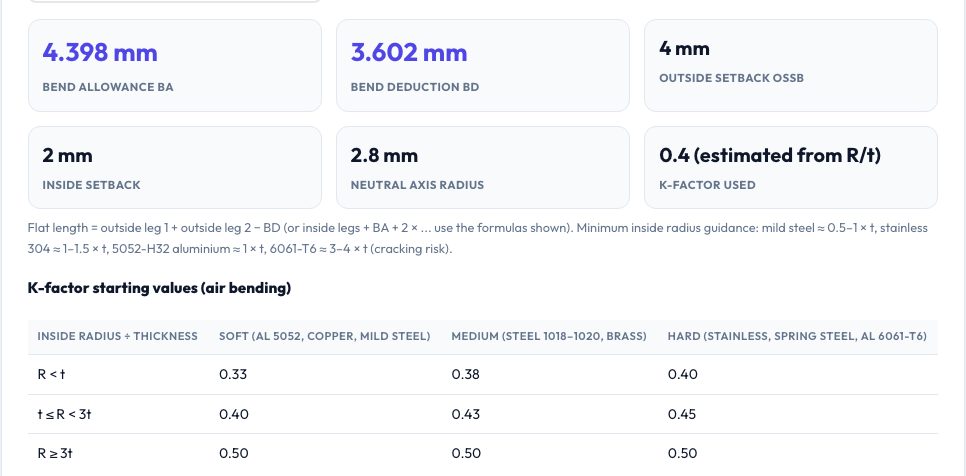
| Inside radius ÷ thickness | Soft (Al 5052, copper, mild steel) | Medium (steel 1018–1020, brass) | Hard (stainless, spring steel, Al 6061-T6) |
|---|---|---|---|
| R < t | 0.33 | 0.38 | 0.40 |
| t ≤ R < 3t | 0.40 | 0.43 | 0.45 |
| R ≥ 3t | 0.50 | 0.50 | 0.50 |
See Sheet Metal Bend Allowance & K-Factor Calculator in action
Free Sheet Metal Bend Allowance Calculator
When sheet metal is bent, the inside compresses and the outside stretches, and a neutral line stays the same length. The bend allowance is the length of that neutral line in the bend: BA = θ·(R + K·t), where θ is the bend angle in radians, R the inside radius, t the thickness and K the K-factor (the neutral axis position as a fraction of the thickness). From it follow the bend deduction (BD = 2·OSSB − BA), the outside setback (OSSB = (R + t)·tan(θ/2)) and the flat blank length of a part with several bends.
The first tab computes BA, BD, setbacks and the neutral radius, estimating K from the R/t ratio if you leave it at zero. The second builds a flat pattern from the outside leg lengths and bend angles of up to ten flanges. The third derives your actual K-factor from a test piece — bend a blank, measure its outside legs and the original flat length — which removes the guesswork for your brake, tooling and material.
Key features
Allowance, deduction, setback
All the standard bend quantities for any angle and radius.
Multi-bend flat pattern
Up to ten flanges with individual angles.
K-factor finder
Calculate K from a measured test bend.
Starting values
K-factor table by R/t and material hardness; minimum radius guidance.
How to use it
- Enter thickness, inside radius and angle.
- Use the estimated K or enter your own.
- Build the flat length in the Flat pattern tab.
- Calibrate K with a test bend if tolerances are tight.
Worked example
Example
2 mm steel, 2 mm inside radius, 90°, K = 0.4: BA = 4.40 mm, outside setback 4.00 mm, BD = 3.60 mm. A part with outside legs 30 + 40 mm needs a flat blank of 66.4 mm.
Who uses this tool
Sheet-metal students and designers
Flat-pattern calculations for CAD and drawings.
Fabricators
Cut blanks accurately before bending.
Makers with a brake
Calibrate K for their own tooling.
Tips for the best results
- Bend a scrap test piece first for critical dimensions.
- Respect the minimum bend radius to avoid cracking.
- Keep flanges longer than about 4 × thickness.
- K-factor depends on tooling and method (air vs bottoming).
Common mistakes to avoid
- Mixing outside and inside dimensions.
- Using 90° when the machine's 'bend angle' means the included angle.
- Assuming one K-factor fits every material and radius.
Why use AZRS QuickFix?
It is 100% free, needs no signup and has no watermark or usage limits. The tool runs in your browser, so what you type stays on your device, and it works on phones, tablets and desktops. New tools are added every week — bookmark this page or browse the full QuickFix toolbox.
Frequently asked questions
What is the K-factor?
The ratio of the neutral axis distance from the inside surface to the thickness (0 to 0.5).
Bend allowance vs deduction?
Allowance is the neutral-line length in the bend; deduction is subtracted from the sum of outside legs.
What angle do I enter?
The angle the material is bent through (90° for a right angle).
Is it exact?
It follows the standard formulas; real parts depend on K, which you can calibrate.