Stepper Steps per mm, Belt Length & Pulley Calculator
Steps per mm for belts and lead screws, belt length and centre distance, speed and torque · free, no signup
See Stepper Steps per mm, Belt Length & Pulley Calculator in action
Free Stepper Steps per mm, Belt Length & Pulley Calculator
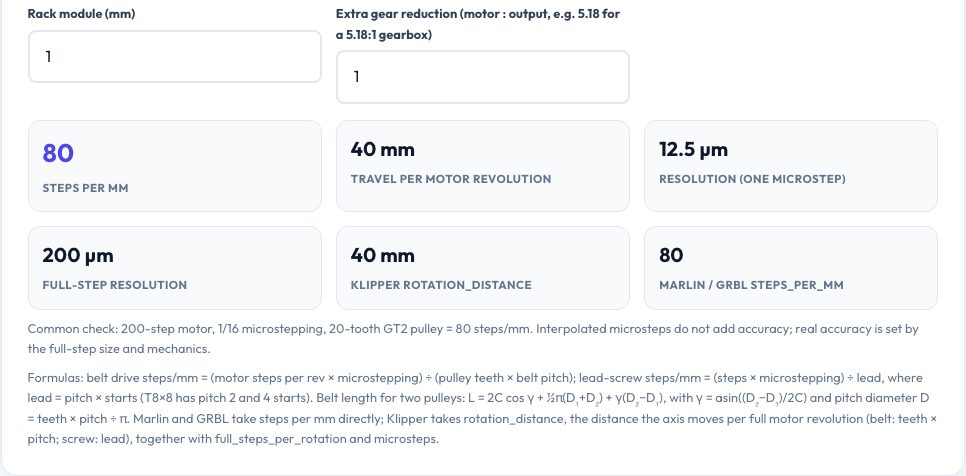
Setting up a 3D printer, CNC or robot axis starts with one number: how many motor steps move the axis one millimetre. This calculator gives you steps per mm for belt-and-pulley drives (GT2, MXL, HTD, T2.5), lead screws (T8 with any lead) and rack-and-pinion drives from the motor's steps per revolution, the microstepping, the pulley teeth and the belt pitch or screw lead, with optional gearbox reduction. It also shows the resolution of one microstep and the rotation_distance value that Klipper wants.
A second tab computes the belt length for two pulleys at a given centre distance using the exact open-belt formula, rounds to a real tooth count and tells you the centre distance that belt will actually give; you can also enter a belt size and find the centre distance. The third tab estimates belt speed, pulley diameter, theoretical pull force and step pulse rate from motor speed and torque, with realistic warnings about speed-torque derating.
Key features
Steps per mm
Belts, lead screws and racks, with microstepping and gearbox ratio.
Klipper and Marlin values
Shows steps_per_mm and rotation_distance.
Belt length and centre distance
Exact open-belt formula, nearest standard tooth count and next size up.
Speed and force
Belt speed, pull force and step rate with derating notes.
How to use it
- Choose belt, screw or rack and enter the motor and microstepping.
- Read steps per mm and rotation_distance.
- Use the belt tab to size a belt for your pulley layout.
- Use the speed tab to sanity-check performance.
Worked example
Example
A 200-step motor with 1/16 microstepping and a 20-tooth GT2 (2 mm pitch) pulley is 80 steps/mm; a 20T/20T GT2 drive at 100 mm centre distance needs 240 mm of belt = 120 teeth exactly; a T8×8 lead screw at 1/16 is 400 steps/mm.
Who uses this tool
3D printer builders
Correct steps/mm for every axis.
CNC and laser builders
Belt sizing and axis calibration.
Robotics hobbyists
Wheel and gearbox calculations.
Tips for the best results
- Use an integer steps/mm where possible for exact moves.
- Add a slot or idler to take up belt length tolerance.
- Remember interpolated microsteps do not add true accuracy.
- Measure real travel and correct with a scaling factor.
Common mistakes to avoid
- Mixing up pitch and lead on multi-start lead screws.
- Using GT2 pitch 2 mm with a 3 mm HTD belt.
- Trusting theoretical torque at high speed.
Why use AZRS QuickFix?
It is 100% free, needs no signup and has no watermark or usage limits. The tool runs in your browser, so what you type stays on your device, and it works on phones, tablets and desktops. New tools are added every week — bookmark this page or browse the full QuickFix toolbox.
Frequently asked questions
What is a multi-start lead screw?
Lead = pitch × starts, e.g. T8×2 with 4 starts has an 8 mm lead.
How accurate is the belt length?
Exact for open belts; add tooth-count rounding and adjustment.
What is rotation_distance?
Distance moved per full motor revolution (Klipper).
Is it free?
Yes.