Print-in-Place Hinge Generator & Snap-Fit Calculator
Generate a working print-in-place hinge STL and calculate snap-fit cantilever deflection and force · free, no signup
See Print-in-Place Hinge Generator & Snap-Fit Calculator in action
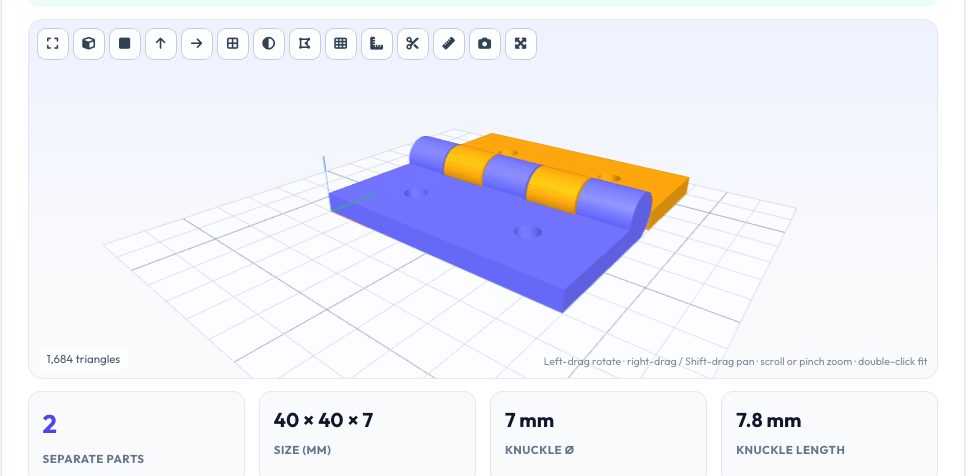
Free Print-in-Place Hinge Generator & Snap-Fit Calculator
A print-in-place hinge is printed assembled: two leaves joined by interleaved knuckles around a pin, separated by a small clearance so they move after printing without supports or assembly. This generator builds one to your size — hinge length, leaf width, 3 to 9 knuckles, pin diameter, wall thickness, leaf thickness, clearance and optional screw holes — and checks that the result is two separate closed solids, so you know the clearance actually separates them. The hinge lies flat on the bed with the pin axis horizontal and needs no supports.
The second tab is a cantilever snap-fit calculator based on the standard Bayer/BASF design method: enter the beam length, thickness and width, choose a material (PLA, PETG, ABS, nylon, PC, PP, POM), the beam shape and the hook depth you need, and it shows the maximum permissible deflection, the strain required, the deflection force and the insertion force for your lead-in angle and friction. Strain limits are conservative short-term values for printed plastic and are halved when the beam bends across layers.
Key features
Working hinge in one print
Pin and knuckles separated by your clearance; two bodies verified.
Fully parametric
Length, leaf, knuckles, pin, wall, thickness, screw holes.
Snap-fit cantilever maths
Deflection, strain, force and insertion force with a hook-depth check.
Materials and orientation
Strain limits for PLA, PETG, ABS, nylon, PC, PP and POM.
How to use it
- Set the hinge size and clearance and generate.
- Confirm 'two separate parts' and download the STL.
- Open the snap-fit tab and enter your beam and material.
- Adjust the beam until the hook-depth check passes.
Worked example
Example
A 40 mm hinge with 5 knuckles, a 3 mm pin and 0.3 mm clearance is two solids of about 2,980 and 2,380 mm³; a 15 mm × 1.5 mm × 6 mm PETG beam at 3.5% strain deflects up to 3.5 mm with a deflection force of roughly 11 N.
Who uses this tool
Makers
Boxes, lids, flaps and folding parts printed in one go.
Product designers
Prototype snap-fit enclosures before injection moulding.
Students
Learn tolerance and strain-based design.
Tips for the best results
- Start with 0.3 mm clearance on a calibrated 0.4 mm nozzle.
- Print hinges flat; pins printed vertically are weaker.
- Make snap beams as long as the space allows — deflection scales with L².
- Use PETG or nylon for snap-fits; PLA is brittle.
Common mistakes to avoid
- Printing the hinge with zero clearance so it fuses solid.
- Orienting a snap beam so it bends across layers.
- Designing a hook deeper than the allowable deflection.
Why use AZRS QuickFix?
It is 100% free, needs no signup and has no watermark or usage limits. The tool runs in your browser, so what you type stays on your device, and it works on phones, tablets and desktops. New tools are added every week — bookmark this page or browse the full QuickFix toolbox.
Frequently asked questions
Do I need supports?
No — the hinge prints flat, with the pin horizontal.
It is stiff after printing — what now?
Flex it several times and increase clearance by 0.05 mm next time.
Is the snap-fit calculator exact?
It is the standard textbook method; test a prototype for critical parts.
Is it private?
Yes — everything runs in your browser.