Second Moment of Area & Section Properties Calculator
Area, centroid, Ix, Iy, section modulus, radius of gyration for common sections · free, no signup
See Second Moment of Area & Section Properties Calculator in action
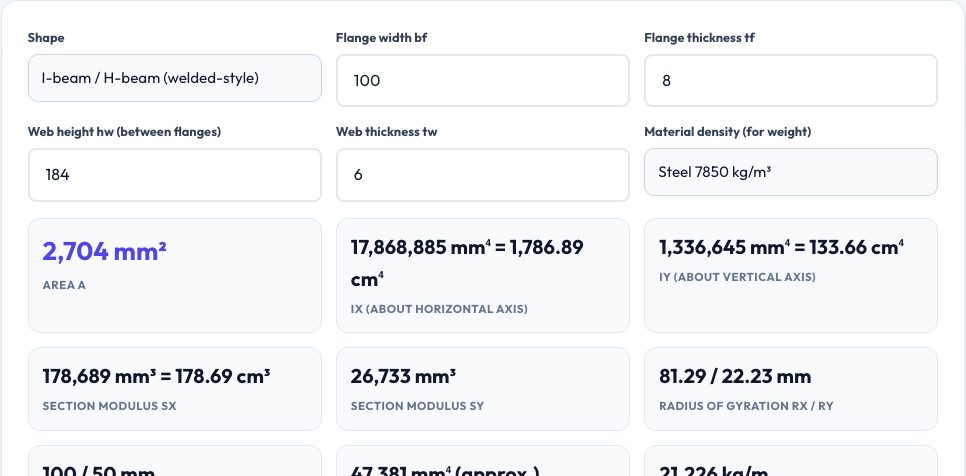
Free Second Moment of Area & Section Properties Calculator
Beam stiffness and strength depend on the cross-section's geometry, not just its area. Select a shape — rectangle, solid round, round tube, rectangular tube, I/H-beam, T-section, channel or angle — enter its dimensions in millimetres and the calculator returns the area, the centroid, the second moments of area Ix and Iy about the centroidal axes, the elastic section moduli, the radii of gyration, an approximate torsion constant J, the extreme-fibre distances and the weight per metre for the density you choose.
Composite shapes are computed with the parallel-axis theorem from their constituent rectangles, and circular shapes with the exact closed-form formulas. A section drawing shows the shape and its centroid. Use the results directly in the beam deflection calculator or any bending-stress calculation.
Key features
Eight common sections
Rectangle, round bar, tube, rectangular tube, I-beam, T, channel, angle.
Full property set
A, centroid, Ix, Iy, Sx, Sy, rx, ry, J and weight per metre.
Exact formulas
Closed-form for circles; parallel-axis composition for the rest.
Drawing
Section sketch with the centroid marked.
How to use it
- Choose the shape.
- Enter its dimensions in mm.
- Read the properties and the extreme-fibre distances.
- Use I and c in your bending or deflection calculation.
Worked example
Example
A 100 × 8 mm flange, 184 × 6 mm web I-beam: area 2704 mm², Ix ≈ 17.87 × 10⁶ mm⁴ (1787 cm⁴), Sx ≈ 178.7 cm³. A 50 × 100 × 5 mm rectangular tube: Ix = 1.737 × 10⁶ mm⁴.
Who uses this tool
Engineering students
Check homework and exam answers.
Fabricators and makers
Compare section options for stiffness per kg.
Designers
Pre-size beams and brackets.
Tips for the best results
- Orient the section so the larger I lines up with the bending direction.
- Hollow sections give most stiffness per kg.
- J is approximate for open thin-walled sections.
- Re-enter dimensions in mm — the calculator does not convert units.
Common mistakes to avoid
- Mixing up Ix and Iy for your bending axis.
- Using nominal catalogue dimensions without fillets and expecting exact tabulated values.
- Forgetting the centroid is not at mid-height for T and angle sections.
Why use AZRS QuickFix?
It is 100% free, needs no signup and has no watermark or usage limits. The tool runs in your browser, so what you type stays on your device, and it works on phones, tablets and desktops. New tools are added every week — bookmark this page or browse the full QuickFix toolbox.
Frequently asked questions
What is second moment of area?
A geometric property (mm⁴) that measures how a cross-section resists bending: I = ∫y² dA.
How is section modulus defined?
S = I ÷ c where c is the distance from the neutral axis to the outer fibre.
Are fillets included?
No — sharp corners are assumed, so values are slightly below catalogue figures.
Can I enter inches?
Use mm; convert inches by multiplying by 25.4.