Keyway & Parallel Key Size Chart and Torque Calculator (DIN 6885)
Look up key width, height and keyway depths for any shaft diameter and check the torque capacity · free, no signup
See Keyway & Parallel Key Size Chart and Torque Calculator (DIN 6885) in action
Free Keyway & Parallel Key Size Calculator (DIN 6885)
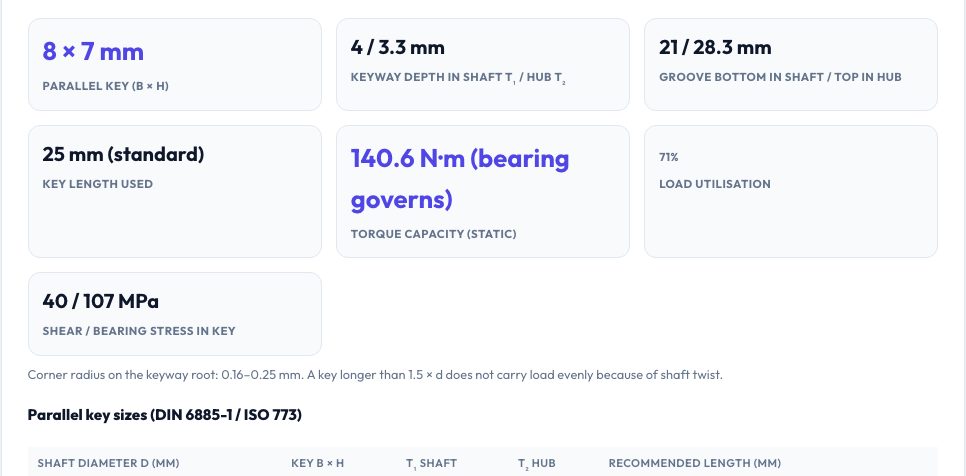
Machining or modelling a keyed shaft needs four numbers: key width, key height, the depth of the keyway in the shaft and in the hub. Enter the shaft diameter and this tool returns the standard parallel key (for example 8 × 7 mm on a 25 mm shaft), keyway depths t1 and t2, the depth from the opposite shaft surface to the groove bottom, a recommended standard key length and a corner radius range.
Add key length, torque and the key material's yield strength to see the torque the key can carry in shear and side bearing with your safety factor, and the utilisation of your load. A full chart for 6–170 mm shafts is included.
Key features
Standard key sizes
DIN 6885-1 / ISO 773 for 6–170 mm shafts.
Keyway depths
t1 shaft, t2 hub, plus groove bottom dimensions.
Torque capacity
Shear and bearing limits with safety factor.
Full chart
All size ranges with recommended lengths.
How to use it
- Enter the shaft diameter.
- Read the key size and depths.
- Optionally add torque, length and material.
- Check utilisation.
Worked example
Example
A 25 mm shaft uses an 8 × 7 mm key with keyway depths t1 = 4.0 mm in the shaft and t2 = 3.3 mm in the hub; a 25 mm long C45 key carries about 140 N·m at a safety factor of 2.
Who uses this tool
Machinists
Cut the right keyway.
Designers
Model keyed shafts.
Students
Check machine design exercises.
Maintenance
Replace keys correctly.
Tips for the best results
- Key length is about 1.0–1.5 × shaft diameter.
- Use two keys 120° apart for high loads.
- Use a keyway corner radius to avoid cracks.
- Use a higher safety factor for shock.
Common mistakes to avoid
- Using the chart for hubs in soft materials without checking bearing.
- Mixing up t1 and t2.
- Ignoring the stress concentration at keyways.
Why use AZRS QuickFix?
It is 100% free, needs no signup and has no watermark or usage limits. The tool runs in your browser, so what you type stays on your device, and it works on phones, tablets and desktops. New tools are added every week — bookmark this page or browse the full QuickFix toolbox.
Frequently asked questions
Which standard is this?
DIN 6885-1 / ISO 773.
What is the shear strength?
Taken as 0.577 × yield.
Is it valid for tapered keys?
No, only parallel keys.
What about inches?
Convert to millimetres first.