
Explore the Build a Nucleus: Protons, Neutrons & Stability
Drag protons and neutrons to build atoms from hydrogen to calcium and check isotopes and stability. Free, no signup, runs in your browser.
- Free to use
- No signup
- Nothing to install
- Runs in your browser
Illustration. Open the tool for the real thing.
See it in action
The Build a Nucleus: Protons, Neutrons & Stability with sample data entered and the result showing.
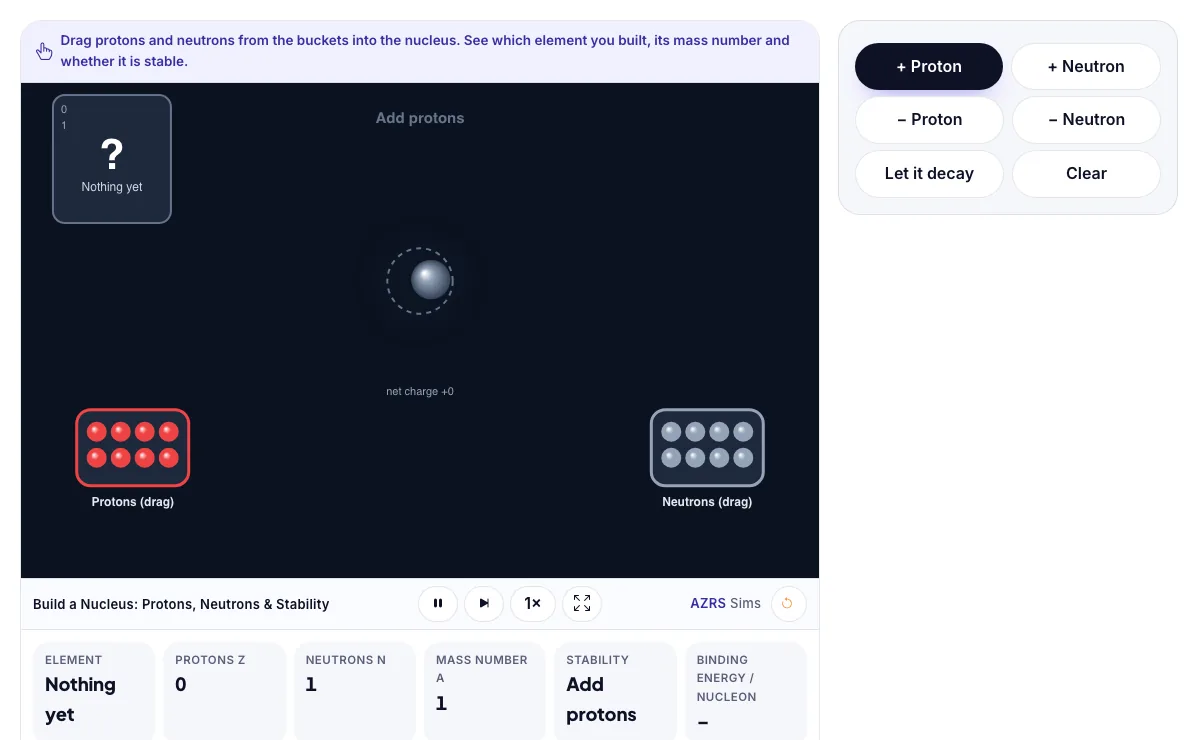
What is the Build a Nucleus: Protons, Neutrons & Stability?
Drag protons and neutrons to build atoms from hydrogen to calcium and check isotopes and stability. It runs in your browser, so a change to a setting or a drag on an object shows up at once.
Isotopes are used in carbon dating, medical imaging, cancer treatment and nuclear power.
3 steps to your result
Open the tool and follow along. Nothing to install.
What you get
The number of protons defines the element.
Mass number = protons + neutrons.
Isotopes have the same protons but different neutrons.
Build carbon-12 and carbon-14.
Build helium-3 and helium-4.
Make an unstable nucleus and press Let it decay.
Used for
Pick one to see how it fits.
Atomic & Quantum learners
Advanced high-school and university students in chemistry and physics, and curious learners who want to see how the atomic world behaves.
Try it freeTeachers
For teachers: project the Build a Nucleus: Protons, Neutrons & Stability on the board, let students predict the result, then run it together and test this: Build helium-3 and helium-4. For students: change one thing at a time and write down what changes.
Try it freeHow it compares
A plain look at this tool next to the usual alternative.
| This simulation | Textbook diagram | |
|---|---|---|
| Interactive | Drag, tap and change settings | Fixed picture |
| Install | Nothing to install | Not needed |
| Cost | Free to use | Depends on the book |
Questions people ask
What is an isotope?
An atom of the same element with a different number of neutrons.
What is beta decay?
A neutron changes into a proton (or the reverse), emitting an electron or positron.
Is the Build a Nucleus: Protons, Neutrons & Stability free to use?
Yes. The Build a Nucleus: Protons, Neutrons & Stability is free, needs no signup or download and runs in your web browser. It is part of the Atomic & Quantum group of AZRS simulations.
Does the Build a Nucleus: Protons, Neutrons & Stability work on a phone or tablet?
Yes. The Build a Nucleus: Protons, Neutrons & Stability takes touch input as well as mouse input, so you can drag its objects with a finger. A larger screen makes the controls and graphs easier to read.
How do I use the Build a Nucleus: Protons, Neutrons & Stability?
1. In the Build a Nucleus: Protons, Neutrons & Stability, press "+ Proton", "+ Neutron", "− Proton", "− Neutron" to start, reset or change what is happening. 2. Start with this experiment: Build carbon-12 and carbon-14. Drag any glowing handle, object or slider with your mouse or finger and the Build a Nucleus: Protons, Neutrons & Stability responds in real time. 3. Change one setting at a time and watch which readout moves, then compare it with this idea: The number of protons defines the element.
More free tools
Related to the Build a Nucleus: Protons, Neutrons & Stability.
Try the Build a Nucleus: Protons, Neutrons & Stability now
Drag protons and neutrons to build atoms from hydrogen to calcium and check isotopes and. Free to use.
Try it free