
Explore the DNA Replication Game
Drag the matching bases onto the unzipped DNA strand to build the copy, or type your own sequence. Free, no signup, runs in your browser.
- Free to use
- No signup
- Nothing to install
- Runs in your browser
See it in action
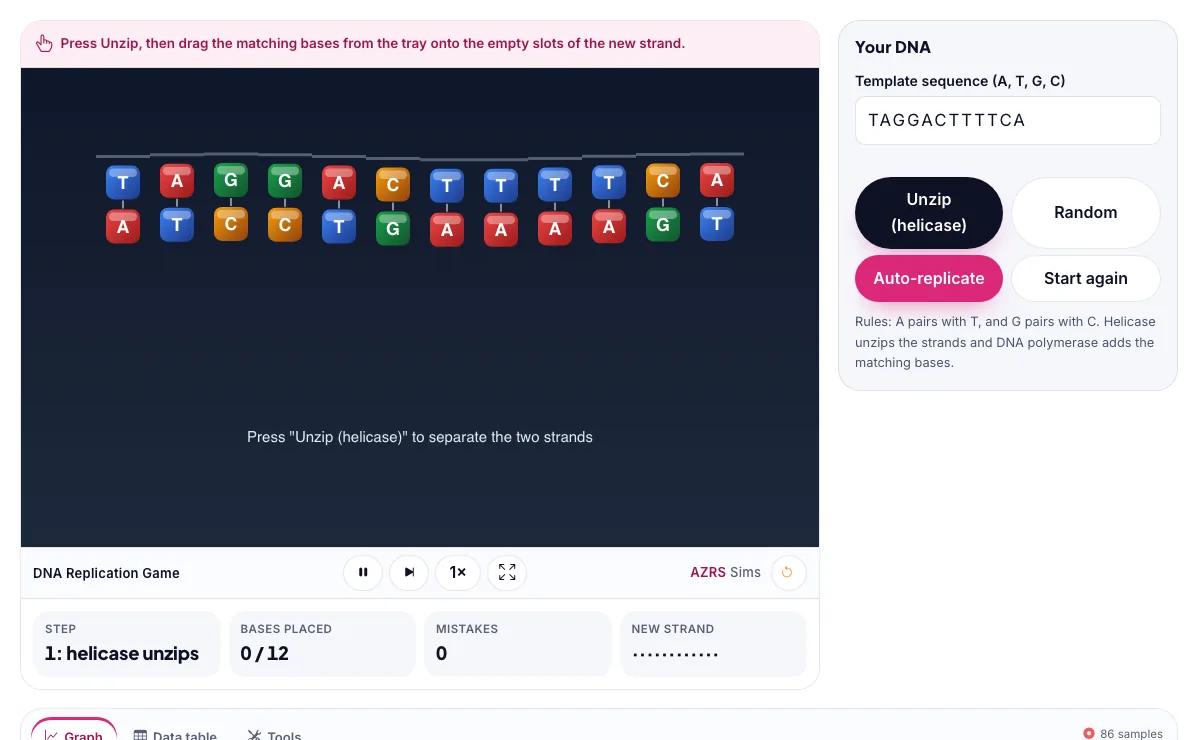
The DNA Replication Game with sample data entered and the result showing.
What is the DNA Replication Game?
Drag the matching bases onto the unzipped DNA strand to build the copy, or type your own sequence. It runs in your browser, so a change to a setting or a drag on an object shows up at once.
DNA copying is the basis of growth, healing and inheritance. Lab techniques like PCR, used in COVID tests and forensics, copy DNA using the same rules.
3 steps to your result
Open the tool and follow along. Nothing to install.
What you get
Adenine pairs with thymine (A-T) and guanine pairs with cytosine (G-C).
Helicase unzips the double helix and DNA polymerase adds matching bases to each strand.
Replication is semi-conservative: each new DNA molecule keeps one old strand and one new strand.
Press Unzip, then drag bases onto the template.
Type your own sequence and copy it.
Try a wrong base and read the feedback.
Used for
Pick one to see how it fits.
Biology learners
Biology students and teachers who want to explore living systems, populations and genetics interactively and safely.
Try it freeTeachers
For teachers: project the DNA Replication Game on the board, let students predict the result, then run it together and test this: Type your own sequence and copy it. For students: change one thing at a time and write down what changes.
Try it freeHow it compares
A plain look at this tool next to the usual alternative.
| This simulation | Textbook diagram | |
|---|---|---|
| Interactive | Drag, tap and change settings | Fixed picture |
| Install | Nothing to install | Not needed |
| Cost | Free to use | Depends on the book |
Questions people ask
Why does replication use base pairing?
Each base can only pair with one partner, so each old strand is a template that fixes the sequence of the new strand exactly.
What does semi-conservative mean?
Each new DNA molecule contains one original strand and one newly made strand.
Is the DNA Replication Game free to use?
Yes. The DNA Replication Game is free, needs no signup or download and runs in your web browser. It is part of the Biology group of AZRS simulations.
Does the DNA Replication Game work on a phone or tablet?
Yes. The DNA Replication Game takes touch input as well as mouse input, so you can use its 1 adjustable settings with a finger. A larger screen makes the controls and graphs easier to read.
How do I use the DNA Replication Game?
1. In the DNA Replication Game, use the controls to change Template sequence (A, T, G, C). The simulation reacts instantly. 2. In the DNA Replication Game, press "Unzip (helicase)", "Random", "Auto-replicate", "Start again" to start, reset or change what is happening. 3. Start with this experiment: Press Unzip, then drag bases onto the template. Drag any glowing handle, object or slider with your mouse or finger and the DNA Replication Game responds in real time. 4. Change one setting at a time and watch which readout moves, then compare it with this idea: Adenine pairs with thymine (A-T) and guanine pairs with cytosine (G-C).
More free tools
Related to the DNA Replication Game.
Try the DNA Replication Game now
Drag the matching bases onto the unzipped DNA strand to build the copy, or type your own. Free to use.
Try it free