
Explore the Energy Skate Park
Drag a skater around a track and watch kinetic, potential and thermal energy trade places. Free, no signup, runs in your browser.
- Free to use
- No signup
- Nothing to install
- Runs in your browser
See it in action
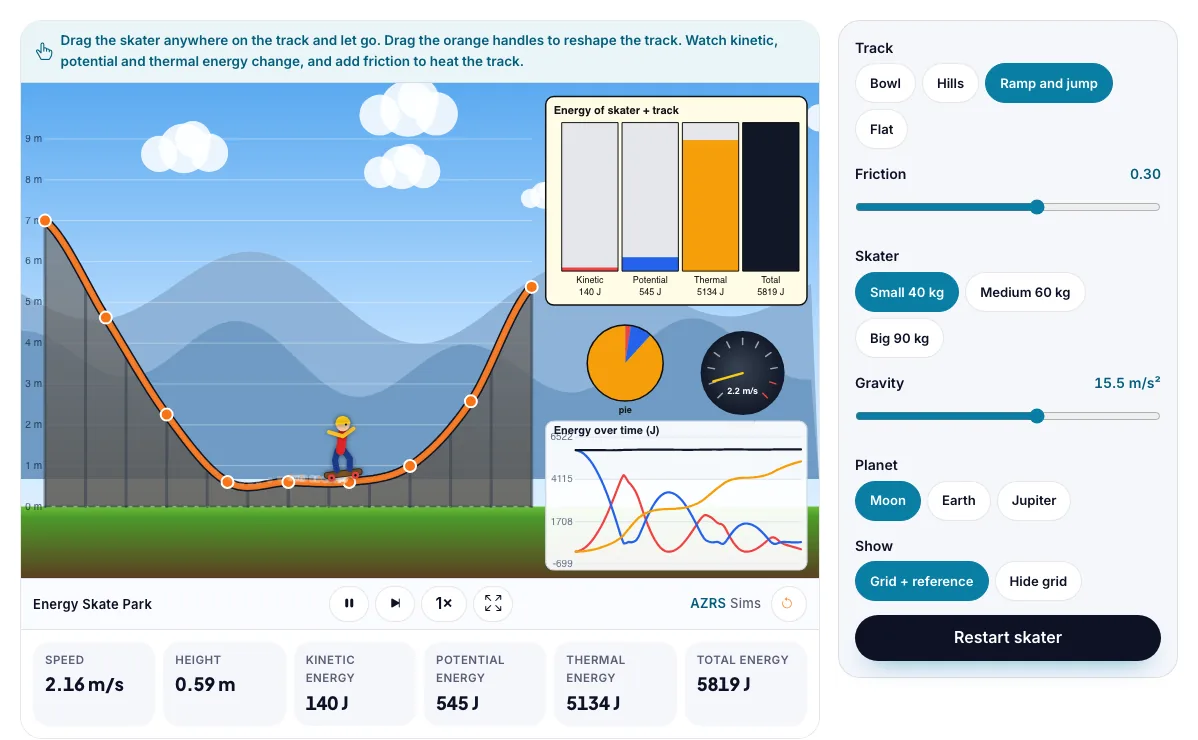
The Energy Skate Park with sample data entered and the result showing.
What is the Energy Skate Park?
Drag a skater around a track and watch kinetic, potential and thermal energy trade places. It runs in your browser, so a change to a setting or a drag on an object shows up at once.
Roller coasters, ski jumps, skate parks, pendulum clocks and hydroelectric dams all rely on energy conversion. Engineers use these ideas to design safe rides and efficient machines.
3 steps to your result
Open the tool and follow along. Nothing to install.
What you get
Total energy stays constant when there is no friction: KE + PE = constant.
Potential energy is highest at the top and kinetic energy is highest at the bottom.
With friction some mechanical energy turns into thermal energy, so the skater never returns to the same height.
Drag the skater to the top of the U-track and release him.
Turn friction on and watch the thermal bar grow.
Try the double-hill track and find the highest point he can reach.
Used for
Pick one to see how it fits.
Physics learners
Physics students in middle school, high school and first-year university, teachers who want a quick demonstration for the projector, and anyone revising for exams.
Try it freeTeachers
For teachers: project the Energy Skate Park on the board, let students predict the result, then run it together and test this: Turn friction on and watch the thermal bar grow. For students: change one thing at a time and write down what changes.
Try it freeHow it compares
A plain look at this tool next to the usual alternative.
| This simulation | Textbook diagram | |
|---|---|---|
| Interactive | Drag, tap and change settings | Fixed picture |
| Install | Nothing to install | Not needed |
| Cost | Free to use | Depends on the book |
Questions people ask
What is conservation of energy?
Energy cannot be created or destroyed, only changed from one form to another. On the track, potential energy converts into kinetic energy and back.
Where does the energy go when there is friction?
It becomes thermal energy (heat) in the track and skater. The total energy is still the same, but the mechanical part slowly decreases.
Is the Energy Skate Park free to use?
Yes. The Energy Skate Park is free, needs no signup or download and runs in your web browser. It is part of the Physics group of AZRS simulations.
Does the Energy Skate Park work on a phone or tablet?
Yes. The Energy Skate Park takes touch input as well as mouse input, so you can use its 5 adjustable settings with a finger. A larger screen makes the controls and graphs easier to read.
How do I use the Energy Skate Park?
1. In the Energy Skate Park, use the controls to change Track, Friction, Skater, Gravity, Planet. The simulation reacts instantly. 2. In the Energy Skate Park, pick an option such as Bowl, Hills, Ramp and jump, Flat to switch modes or load an example. 3. In the Energy Skate Park, press "Restart skater" to start, reset or change what is happening. 4. Start with this experiment: Drag the skater to the top of the U-track and release him. Drag any glowing handle, object or slider with your mouse or finger and the Energy Skate Park responds in real time. 5. Change one setting at a time and watch which readout moves, then compare it with this idea: Total energy stays constant when there is no friction: KE + PE = constant.
More free tools
Related to the Energy Skate Park.
Try the Energy Skate Park now
Drag a skater around a track and watch kinetic, potential and thermal energy trade places. Free to use.
Try it free