
Use the Buddhist Calendar 2026
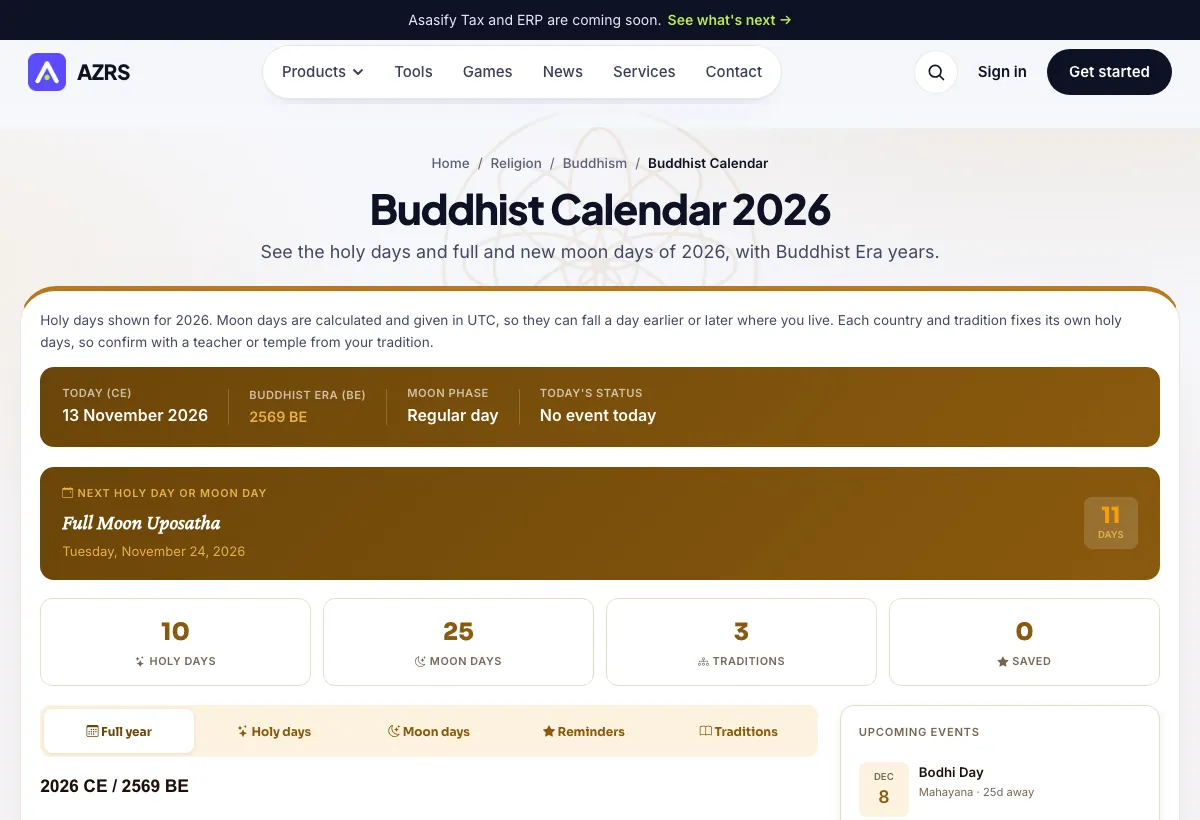
See the holy days and full and new moon days of 2026, with Buddhist Era years.
- Free to use
- No signup
- Nothing to install
- Works in any modern browser
Tab: Moon Days, year 2026
Full moon on 26 September 2026
New moon on 10 October 2026
Open the Buddhist Calendar 2026
Illustration. Open the tool for the real thing.
See it in action
Shown running with its default sample values
What is the Buddhist Calendar 2026?
Most Buddhist observances follow the phases of the moon. Many Theravada communities keep Uposatha on the full moon and new moon, and some also keep the quarter moons. Larger holy days, such as Vesak, Magha Puja and Asalha Puja, fall on particular full moons. This page puts those days on a 2026 calendar so you can see them at a glance.
The year view shows every month with holy days, full moons and new moons marked. The Holy Days tab lets you search the list and filter by Theravada, Mahayana or Vajrayana. The Moon Days tab lists each Uposatha day and has a simple tracker where you can mark the days you observed. A banner counts down to the next holy day or moon day.
3 steps to your result
Open the tool and follow along. Nothing to install.
Scroll the twelve months. Marked days are holy days, full moons or new moons, and today is highlighted.
See every full and new moon of the year and tick the days you observed in the tracker.
Star a holy day to keep it under Reminders. It is saved in this browser only.
What you get
Check whether your temple keeps the day the page shows or the day before or after.
Use the tradition filter if you follow Theravada, Mahayana or Vajrayana, so you see only the days that matter to you.
Remember that moon dates are in universal time. In the Americas the evening of the full moon can fall on the previous date.
The tracker and stars are stored in your browser. Clearing site data resets them.
AZRS tools are free to open and use.
It opens in your browser, so there is nothing to download.
How it compares
A plain look at this tool next to the usual alternative.
| This religion tool | Desktop software | |
|---|---|---|
| Install | Nothing to install | Usually an app or program to install |
| Account | No signup | Depends on the product |
| Cost | Free to use | Free or paid, depends on the product |
Questions people ask
What is Uposatha?
Uposatha is an observance day tied to the moon. In many Theravada communities, monastics recite the monastic rules on these days, and lay people may take extra precepts, listen to teachings or meditate. How it is kept varies by community.
Why do sources give different dates for Vesak?
Vesak is kept on a full moon, but countries count lunar months differently, and some add a leap month. Because there are two full moons in May 2026, countries can choose different days. Ask your own temple which day it keeps.
What is the Buddhist Era?
The Buddhist Era counts years from the time of the Buddha's passing. Many Theravada countries use it. In common calendars it is the Gregorian year plus 543, so 2026 is 2569 BE.
Are the moon dates astronomical?
Yes. The full and new moon dates are calculated from the moon's motion and shown in universal time. They can differ by a day from your local date.
Why are some Tibetan or Mahayana days missing?
Only days with a clear published date for 2026 are listed. Other days, including many Tibetan lunar observances, depend on calendars not included here, so ask a teacher in your tradition.
Please note. Guidance only. Traditions differ; ask a teacher from your own tradition.
More free tools
Related to the Buddhist Calendar 2026.
Try the Buddhist Calendar 2026 now
Holy days, Uposatha moon days and Buddhist Era years for 2026. Free to use.
Try it free