
Explore the Limiting Reagent & Stoichiometry Calculator
Type any reaction, enter grams of each reactant and find the limiting reagent and yield. Free, no signup, runs in your browser.
- Free to use
- No signup
- Nothing to install
- Runs in your browser
Illustration. Open the tool for the real thing.
See it in action
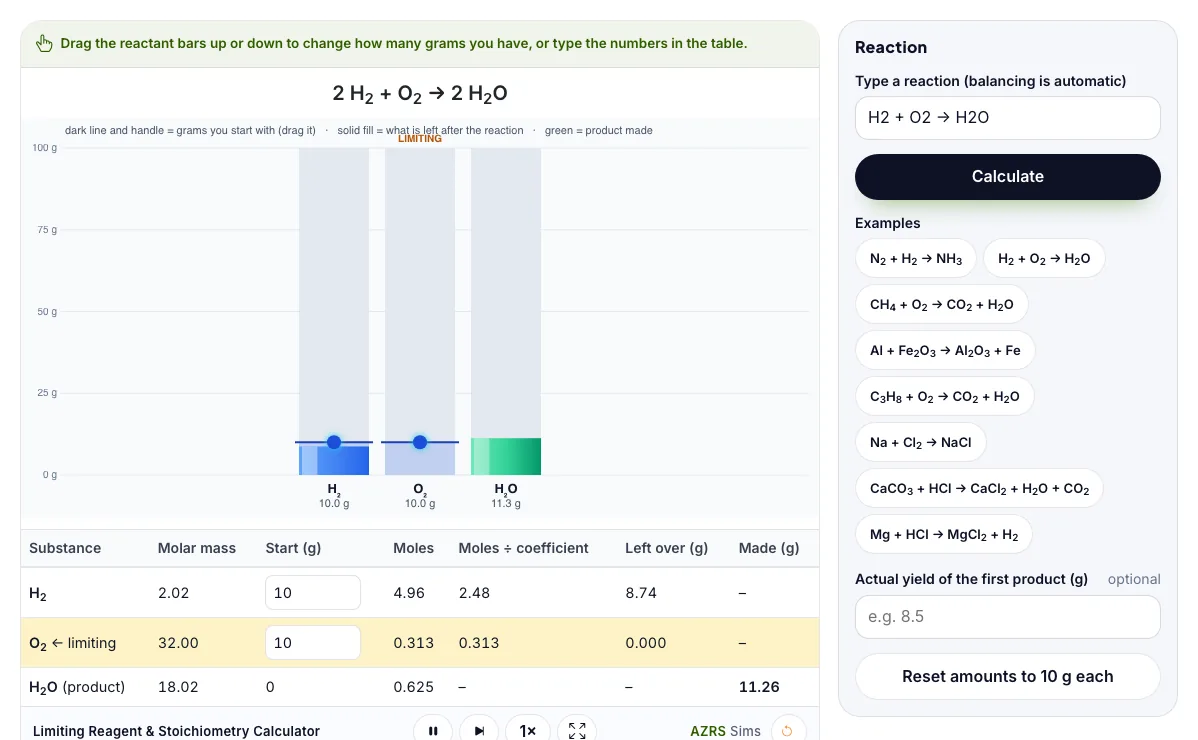
The Limiting Reagent & Stoichiometry Calculator with sample data entered and the result showing.
What is the Limiting Reagent & Stoichiometry Calculator?
Type any reaction, enter grams of each reactant and find the limiting reagent and yield. It runs in your browser, so a change to a setting or a drag on an object shows up at once.
Chemical plants, pharmaceutical labs and food manufacturers all calculate limiting reagents so they do not waste expensive chemicals. It is also a core skill in every chemistry exam.
3 steps to your result
Open the tool and follow along. Nothing to install.
What you get
The limiting reagent is the reactant that runs out first and decides how much product you can make.
Convert grams to moles, then divide by the coefficient to compare reactants fairly.
Percent yield = actual yield ÷ theoretical yield × 100.
Load the ammonia reaction and give it 10 g of N₂ and 10 g of H₂.
Type your own reaction, for example Al + Fe2O3 -> Al2O3 + Fe.
Change the grams and watch the limiting reagent switch.
Used for
Pick one to see how it fits.
Chemistry learners
Chemistry students from middle school to university, teachers who need a virtual demonstration, and anyone without access to a lab.
Try it freeTeachers
For teachers: project the Limiting Reagent & Stoichiometry Calculator on the board, let students predict the result, then run it together and test this: Type your own reaction, for example Al + Fe2O3 -> Al2O3 + Fe. For students: change one thing at a time and write down what changes.
Try it freeHow it compares
A plain look at this tool next to the usual alternative.
| This simulation | Textbook diagram | |
|---|---|---|
| Interactive | Drag, tap and change settings | Fixed picture |
| Install | Nothing to install | Not needed |
| Cost | Free to use | Depends on the book |
Questions people ask
How do you find the limiting reagent?
Convert each reactant to moles and divide by its coefficient in the balanced equation. The smallest result is the limiting reagent.
What is theoretical yield?
The maximum amount of product you could make if the reaction went perfectly, calculated from the limiting reagent.
Is the Limiting Reagent & Stoichiometry Calculator free to use?
Yes. The Limiting Reagent & Stoichiometry Calculator is free, needs no signup or download and runs in your web browser. It is part of the Chemistry group of AZRS simulations.
Does the Limiting Reagent & Stoichiometry Calculator work on a phone or tablet?
Yes. The Limiting Reagent & Stoichiometry Calculator takes touch input as well as mouse input, so you can use its 2 adjustable settings with a finger. A larger screen makes the controls and graphs easier to read.
How do I use the Limiting Reagent & Stoichiometry Calculator?
1. In the Limiting Reagent & Stoichiometry Calculator, use the controls to change Type a reaction (balancing is automatic), Actual yield of the first product (g). The simulation reacts instantly. 2. In the Limiting Reagent & Stoichiometry Calculator, press "Calculate", "Reset amounts to 10 g each" to start, reset or change what is happening. 3. Start with this experiment: Load the ammonia reaction and give it 10 g of N₂ and 10 g of H₂. Drag any glowing handle, object or slider with your mouse or finger and the Limiting Reagent & Stoichiometry Calculator responds in real time. 4. Change one setting at a time and watch which readout moves, then compare it with this idea: The limiting reagent is the reactant that runs out first and decides how much product you can make.
More free tools
Related to the Limiting Reagent & Stoichiometry Calculator.
Try the Limiting Reagent & Stoichiometry Calculator now
Type any reaction, enter grams of each reactant and find the limiting reagent and yield. Free to use.
Try it free