
Explore the Neuron & Action Potential Simulator
Stimulate a neuron and watch it fire (or fail to fire) an action potential, with a live resting → threshold → depolarization → repolarization →.
- Free to use
- No signup
- Nothing to install
- Runs in your browser
Illustration. Open the tool for the real thing.
See it in action
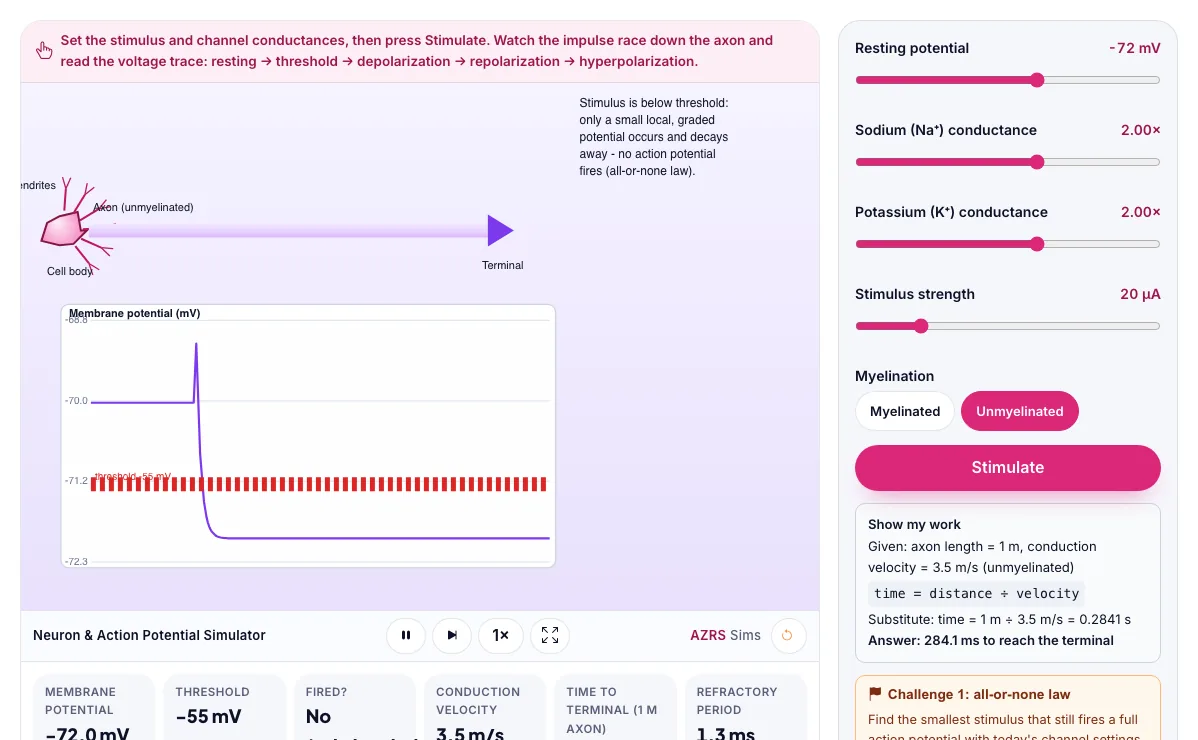
The Neuron & Action Potential Simulator with sample data entered and the result showing.
What is the Neuron & Action Potential Simulator?
Stimulate a neuron and watch it fire (or fail to fire) an action potential, with a live resting → threshold → depolarization → repolarization → hyperpolarization voltage graph. It runs in your browser, so a change to a setting or a drag on an object shows up at once.
This is exactly how doctors interpret nerve conduction studies, and why multiple sclerosis (which damages myelin) slows and sometimes blocks nerve signals.
3 steps to your result
Open the tool and follow along. Nothing to install.
What you get
An action potential only fires once the stimulus reaches threshold - the all-or-none law.
Depolarization is caused by sodium (Na⁺) rushing in; repolarization by potassium (K⁺) rushing out.
A myelinated axon conducts much faster because the signal jumps between nodes of Ranvier (saltatory conduction).
Set the stimulus just below threshold and watch the graded potential fade without firing.
Switch off myelination and compare how long the impulse takes to reach the terminal.
Raise potassium conductance and watch the hyperpolarization deepen.
Used for
Pick one to see how it fits.
Biology learners
Biology students and teachers who want to explore living systems, populations and genetics interactively and safely.
Try it freeTeachers
For teachers: project the Neuron & Action Potential Simulator on the board, let students predict the result, then run it together and test this: Switch off myelination and compare how long the impulse takes to reach the terminal. For students: change one thing at a time and write down what changes.
Try it freeHow it compares
A plain look at this tool next to the usual alternative.
| This simulation | Textbook diagram | |
|---|---|---|
| Interactive | Drag, tap and change settings | Fixed picture |
| Install | Nothing to install | Not needed |
| Cost | Free to use | Depends on the book |
Questions people ask
What is the all-or-none law?
Once a stimulus reaches threshold, the action potential always fires at full size; stronger stimuli do not make a bigger spike, only more frequent ones.
Why is myelinated conduction so much faster?
The signal skips along by jumping from one node of Ranvier to the next instead of regenerating continuously along the whole membrane.
Is the Neuron & Action Potential Simulator free to use?
Yes. The Neuron & Action Potential Simulator is free, needs no signup or download and runs in your web browser. It is part of the Biology group of AZRS simulations.
Does the Neuron & Action Potential Simulator work on a phone or tablet?
Yes. The Neuron & Action Potential Simulator takes touch input as well as mouse input, so you can use its 5 adjustable settings with a finger. A larger screen makes the controls and graphs easier to read.
How do I use the Neuron & Action Potential Simulator?
1. In the Neuron & Action Potential Simulator, use the controls to change Resting potential, Sodium (Na⁺) conductance, Potassium (K⁺) conductance, Stimulus strength, Myelination. The simulation reacts instantly. 2. In the Neuron & Action Potential Simulator, pick an option such as Myelinated, Unmyelinated to switch modes or load an example. 3. In the Neuron & Action Potential Simulator, press "Stimulate", "Check my stimulus", "Check both conditions" to start, reset or change what is happening. 4. Start with this experiment: Set the stimulus just below threshold and watch the graded potential fade without firing. Drag any glowing handle, object or slider with your mouse or finger and the Neuron & Action Potential Simulator responds in real time. 5. Change one setting at a time and watch which readout moves, then compare it with this idea: An action potential only fires once the stimulus reaches threshold - the all-or-none law.
More free tools
Related to the Neuron & Action Potential Simulator.
Try the Neuron & Action Potential Simulator now
Stimulate a neuron and watch it fire (or fail to fire) an action potential, with a live. Free to use.
Try it free