
Explore the Orbital Motion & Gravity Simulator
Launch a planet around a star and see circular, elliptical and escape orbits. Free, no signup, runs in your browser.
- Free to use
- No signup
- Nothing to install
- Runs in your browser
Illustration. Open the tool for the real thing.
See it in action
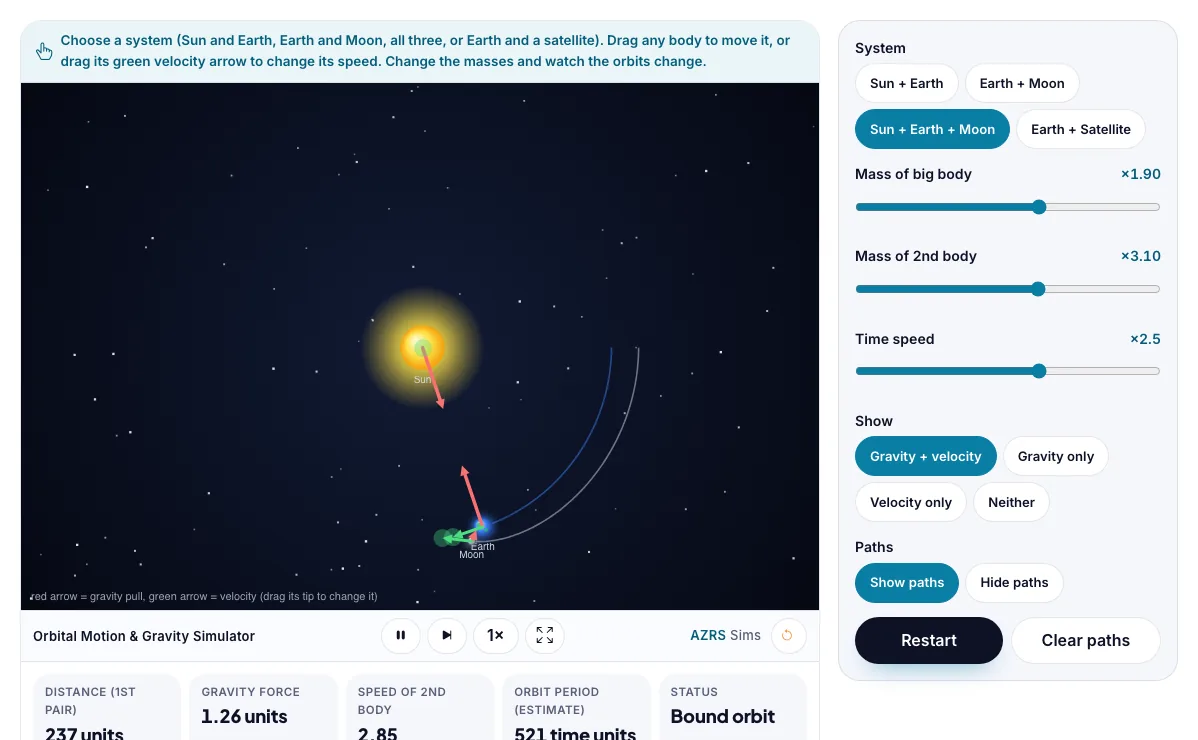
The Orbital Motion & Gravity Simulator with sample data entered and the result showing.
What is the Orbital Motion & Gravity Simulator?
Launch a planet around a star and see circular, elliptical and escape orbits. It runs in your browser, so a change to a setting or a drag on an object shows up at once.
Satellite engineers, astronomers and space agencies use orbital mechanics to place GPS, weather and communication satellites and to plan missions to other planets.
3 steps to your result
Open the tool and follow along. Nothing to install.
What you get
Gravity follows an inverse-square law: double the distance, a quarter of the force.
Launch at the circular speed for a circle; faster gives an ellipse, and past escape speed the planet leaves.
Kepler's third law: the period squared is proportional to the semi-major axis cubed.
Set the launch speed to 1.00× for a circle.
Raise it to 1.3× to get an ellipse.
Go above 1.41× to escape.
Used for
Pick one to see how it fits.
Physics learners
Physics students in middle school, high school and first-year university, teachers who want a quick demonstration for the projector, and anyone revising for exams.
Try it freeTeachers
For teachers: project the Orbital Motion & Gravity Simulator on the board, let students predict the result, then run it together and test this: Raise it to 1.3× to get an ellipse. For students: change one thing at a time and write down what changes.
Try it freeHow it compares
A plain look at this tool next to the usual alternative.
| This simulation | Textbook diagram | |
|---|---|---|
| Interactive | Drag, tap and change settings | Fixed picture |
| Install | Nothing to install | Not needed |
| Cost | Free to use | Depends on the book |
Questions people ask
What is escape velocity?
The minimum speed needed to leave a body's gravity and never return. It is √2 times the circular orbital speed at that distance.
Why are orbits ellipses?
For an inverse-square force the closed orbits are ellipses with the star at one focus. A circle is the special case with eccentricity 0.
Is the Orbital Motion & Gravity Simulator free to use?
Yes. The Orbital Motion & Gravity Simulator is free, needs no signup or download and runs in your web browser. It is part of the Physics group of AZRS simulations.
Does the Orbital Motion & Gravity Simulator work on a phone or tablet?
Yes. The Orbital Motion & Gravity Simulator takes touch input as well as mouse input, so you can use its 5 adjustable settings with a finger. A larger screen makes the controls and graphs easier to read.
How do I use the Orbital Motion & Gravity Simulator?
1. In the Orbital Motion & Gravity Simulator, use the controls to change System, Mass of big body, Mass of 2nd body, Time speed, Paths. The simulation reacts instantly. 2. In the Orbital Motion & Gravity Simulator, pick an option such as Sun + Earth, Earth + Moon, Sun + Earth + Moon, Earth + Satellite to switch modes or load an example. 3. In the Orbital Motion & Gravity Simulator, press "Restart", "Clear paths" to start, reset or change what is happening. 4. Start with this experiment: Set the launch speed to 1.00× for a circle. Drag any glowing handle, object or slider with your mouse or finger and the Orbital Motion & Gravity Simulator responds in real time. 5. Change one setting at a time and watch which readout moves, then compare it with this idea: Gravity follows an inverse-square law: double the distance, a quarter of the force.
More free tools
Related to the Orbital Motion & Gravity Simulator.
Try the Orbital Motion & Gravity Simulator now
Launch a planet around a star and see circular, elliptical and escape orbits. Free to use.
Try it free