
Explore the Plate Tectonics & Earthquakes
Watch plates collide, spread apart and slide past each other to build volcanoes, ridges and earthquakes. Free, no signup, runs in your browser.
- Free to use
- No signup
- Nothing to install
- Runs in your browser
Illustration. Open the tool for the real thing.
See it in action
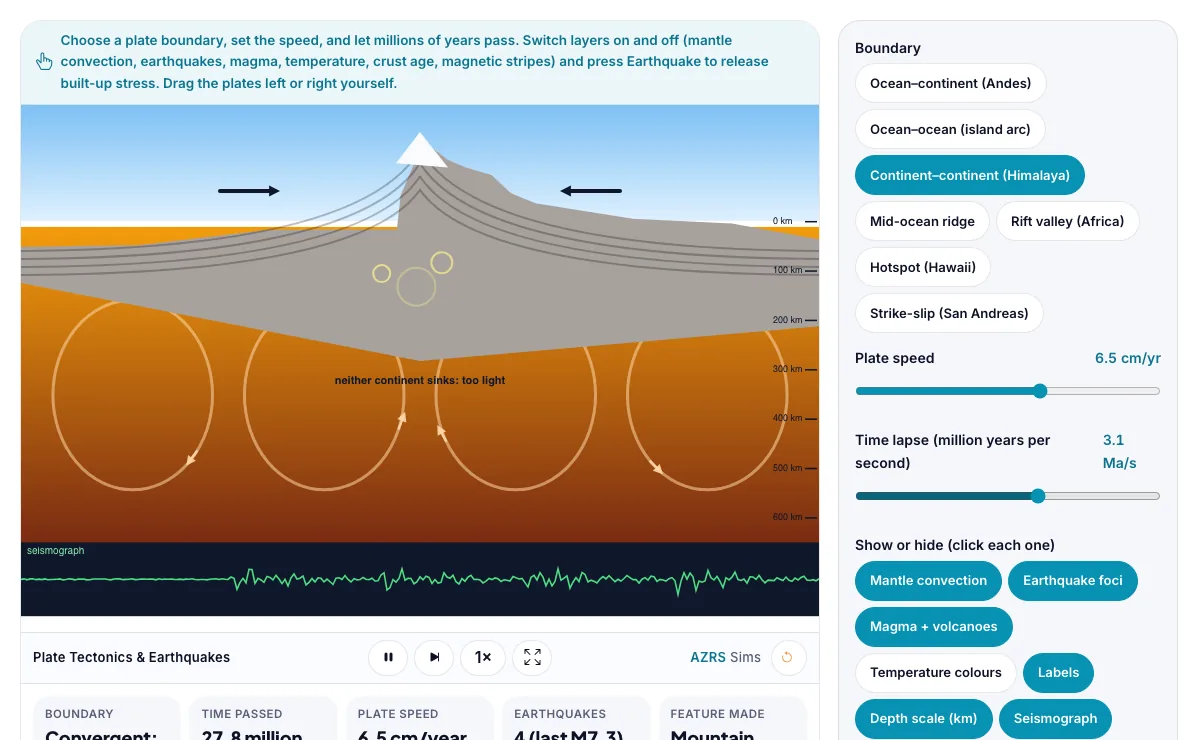
The Plate Tectonics & Earthquakes with sample data entered and the result showing.
What is the Plate Tectonics & Earthquakes?
Watch plates collide, spread apart and slide past each other to build volcanoes, ridges and earthquakes. It runs in your browser, so a change to a setting or a drag on an object shows up at once.
Understanding plate boundaries helps predict volcanic and earthquake hazards and find mineral and energy resources.
3 steps to your result
Open the tool and follow along. Nothing to install.
What you get
The crust is broken into moving plates.
At convergent boundaries plates collide and one can sink (subduction).
At divergent boundaries plates move apart and new crust forms.
Watch a volcano form at the convergent boundary.
Speed up the divergent boundary and see new crust stripes.
Count the earthquakes on the transform fault.
Used for
Pick one to see how it fits.
Earth & Space learners
Astronomy and earth-science students, and teachers who need a visual model to explain what is happening in the sky.
Try it freeTeachers
For teachers: project the Plate Tectonics & Earthquakes on the board, let students predict the result, then run it together and test this: Speed up the divergent boundary and see new crust stripes. For students: change one thing at a time and write down what changes.
Try it freeHow it compares
A plain look at this tool next to the usual alternative.
| This simulation | Textbook diagram | |
|---|---|---|
| Interactive | Drag, tap and change settings | Fixed picture |
| Install | Nothing to install | Not needed |
| Cost | Free to use | Depends on the book |
Questions people ask
Why do plates move?
Heat from inside the Earth drives slow convection currents in the mantle, and plates are also pulled by their sinking edges.
What causes an earthquake?
Stress builds up along a fault until the rock suddenly slips and releases energy as waves.
Is the Plate Tectonics & Earthquakes free to use?
Yes. The Plate Tectonics & Earthquakes is free, needs no signup or download and runs in your web browser. It is part of the Earth & Space group of AZRS simulations.
Does the Plate Tectonics & Earthquakes work on a phone or tablet?
Yes. The Plate Tectonics & Earthquakes takes touch input as well as mouse input, so you can use its 4 adjustable settings with a finger. A larger screen makes the controls and graphs easier to read.
How do I use the Plate Tectonics & Earthquakes?
1. In the Plate Tectonics & Earthquakes, use the controls to change Boundary, Plate speed, Time lapse (million years per second), Show or hide (click each one). The simulation reacts instantly. 2. In the Plate Tectonics & Earthquakes, pick an option such as Ocean–continent (Andes), Ocean–ocean (island arc), Continent–continent (Himalaya), Mid-ocean ridge to switch modes or load an example. 3. In the Plate Tectonics & Earthquakes, press "Earthquake!", "Reset" to start, reset or change what is happening. 4. Start with this experiment: Watch a volcano form at the convergent boundary. Drag any glowing handle, object or slider with your mouse or finger and the Plate Tectonics & Earthquakes responds in real time. 5. Change one setting at a time and watch which readout moves, then compare it with this idea: The crust is broken into moving plates.
More free tools
Related to the Plate Tectonics & Earthquakes.
Try the Plate Tectonics & Earthquakes now
Watch plates collide, spread apart and slide past each other to build volcanoes, ridges. Free to use.
Try it free