
Explore the Redox Tracker
Analyse any redox reaction you type, see who is oxidised and reduced, then test yourself. Free, no signup, runs in your browser.
- Free to use
- No signup
- Nothing to install
- Runs in your browser
See it in action
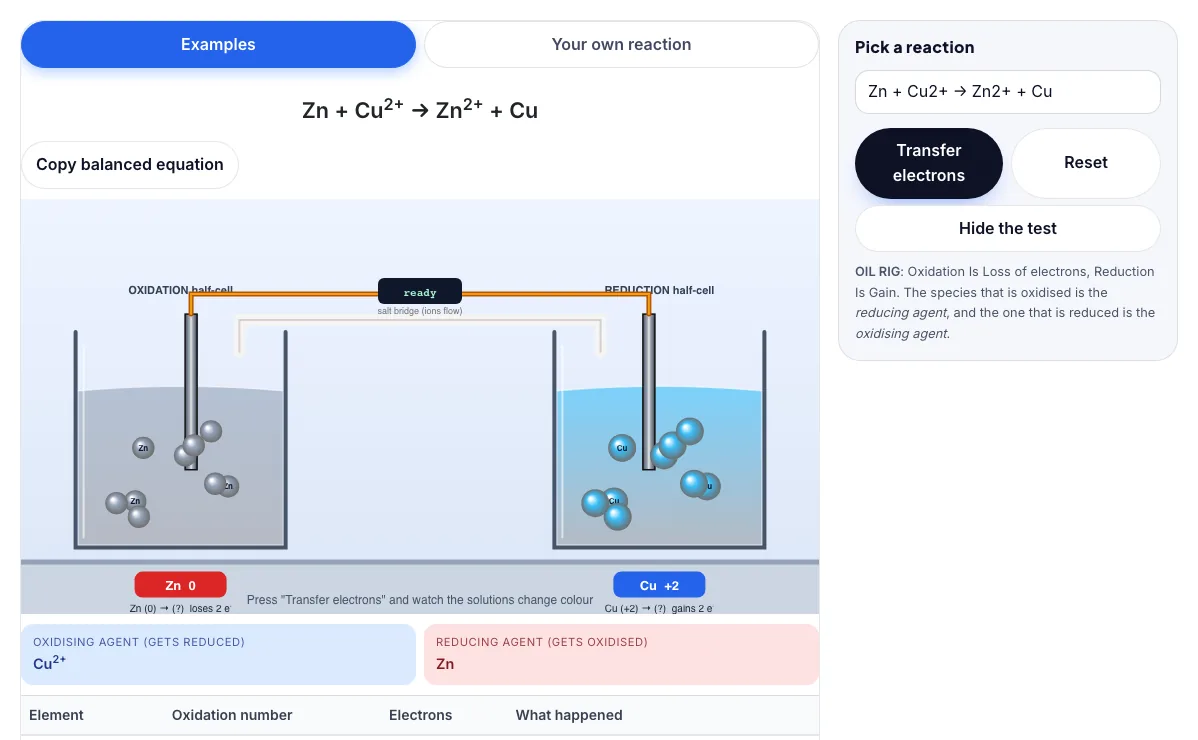
The Redox Tracker with sample data entered and the result showing.
What is the Redox Tracker?
Analyse any redox reaction you type, see who is oxidised and reduced, then test yourself. It runs in your browser, so a change to a setting or a drag on an object shows up at once.
Redox reactions power batteries, rust, respiration, photosynthesis, bleaching and combustion.
3 steps to your result
Open the tool and follow along. Nothing to install.
What you get
Oxidation is loss of electrons and reduction is gain of electrons (OIL RIG).
The species that is oxidised is the reducing agent.
The species that is reduced is the oxidising agent.
Type your own reaction, for example Sn^2+ + Fe^3+ -> Sn^4+ + Fe^2+
Try Cu + HNO3 -> Cu(NO3)2 + NO2 + H2O and find which element changes oxidation number.
Press Test myself, fill in every oxidation number, then press Check.
Used for
Pick one to see how it fits.
Electrochemistry learners
Chemistry students studying redox, batteries and electrolysis, and teachers who want a clear picture of where the electrons go.
Try it freeTeachers
For teachers: project the Redox Tracker (Oxidation Numbers) on the board, let students predict the result, then run it together and test this: Try Cu + HNO3 -> Cu(NO3)2 + NO2 + H2O and find which element changes oxidation number. For students: change one thing at a time and write down what changes.
Try it freeHow it compares
A plain look at this tool next to the usual alternative.
| This simulation | Textbook diagram | |
|---|---|---|
| Interactive | Drag, tap and change settings | Fixed picture |
| Install | Nothing to install | Not needed |
| Cost | Free to use | Depends on the book |
Questions people ask
What does OIL RIG mean?
Oxidation Is Loss, Reduction Is Gain, of electrons.
Can oxidation happen without reduction?
No. Electrons lost by one species must be gained by another, so the two always happen together.
Is the Redox Tracker (Oxidation Numbers) free to use?
Yes. The Redox Tracker (Oxidation Numbers) is free, needs no signup or download and runs in your web browser. It is part of the Electrochemistry group of AZRS simulations.
Does the Redox Tracker (Oxidation Numbers) work on a phone or tablet?
Yes. The Redox Tracker (Oxidation Numbers) takes touch input as well as mouse input, so you can drag its objects with a finger. A larger screen makes the controls and graphs easier to read.
How do I use the Redox Tracker?
1. In the Redox Tracker (Oxidation Numbers), press "Transfer electrons", "Reset", "Test myself" to start, reset or change what is happening. 2. Start with this experiment: Type your own reaction, for example Sn^2+ + Fe^3+ -> Sn^4+ + Fe^2+. Drag any glowing handle, object or slider with your mouse or finger and the Redox Tracker (Oxidation Numbers) responds in real time. 3. Change one setting at a time and watch which readout moves, then compare it with this idea: Oxidation is loss of electrons and reduction is gain of electrons (OIL RIG).
More free tools
Related to the Redox Tracker.
Try the Redox Tracker now
Analyse any redox reaction you type, see who is oxidised and reduced, then test yourself. Free to use.
Try it free