
Explore the Rock Cycle Laboratory
Drag a rock sample through weathering, compaction, heat and pressure and watch it transform between igneous, sedimentary and metamorphic rock.
- Free to use
- No signup
- Nothing to install
- Runs in your browser
Illustration. Open the tool for the real thing.
See it in action
The Rock Cycle Laboratory with sample data entered and the result showing.
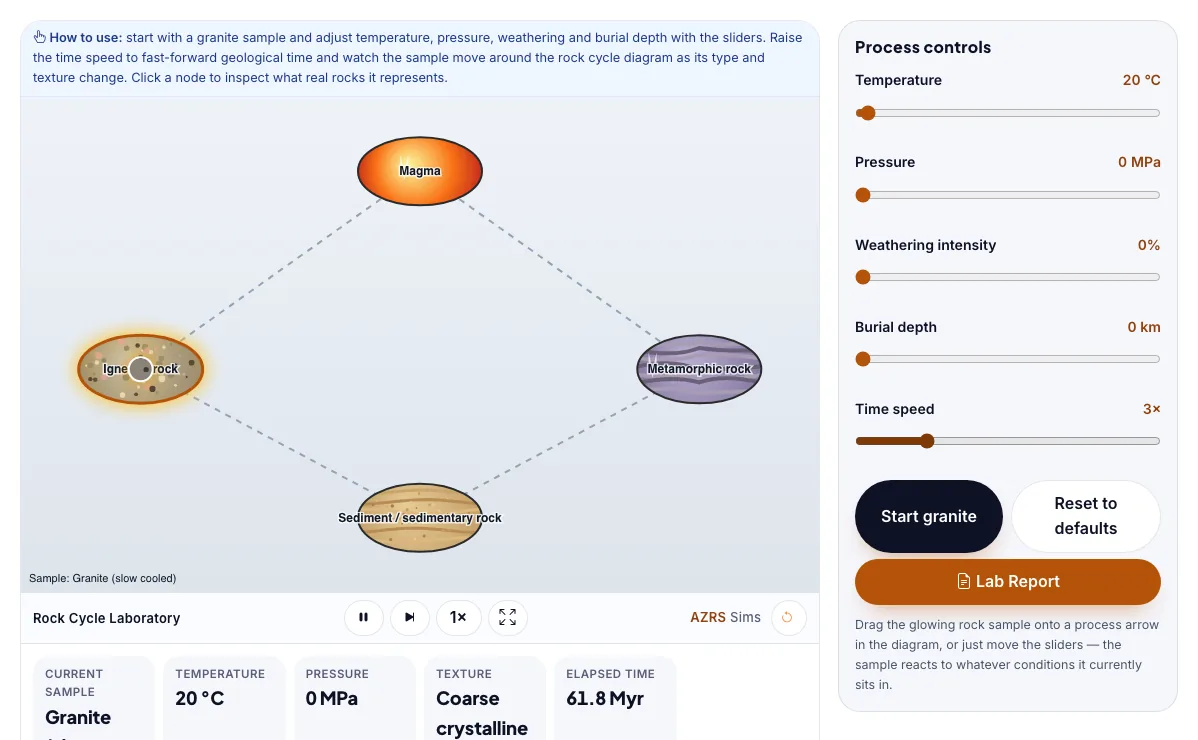
What is the Rock Cycle Laboratory?
Drag a rock sample through weathering, compaction, heat and pressure and watch it transform between igneous, sedimentary and metamorphic rock. It runs in your browser, so a change to a setting or a drag on an object shows up at once.
Geologists read rock textures in the field to reconstruct a region's entire thermal and tectonic history, from ancient mountain-building to burial and uplift.
3 steps to your result
Open the tool and follow along. Nothing to install.
What you get
The rock cycle has no fixed starting point: any rock can become any other type given the right conditions.
Weathering and compaction turn igneous or metamorphic rock into sediment, then sedimentary rock.
Heat and pressure below the melting point cause metamorphism; above it, the rock melts into magma instead.
Heat granite past 800°C and watch it melt to magma.
Weather a rock, then bury and compact it into sedimentary rock.
Complete the challenge: turn granite into a metamorphic rock without melting it.
Used for
Pick one to see how it fits.
Teachers
For teachers: project the Rock Cycle Laboratory on the board, let students predict the result, then run it together and test this: Weather a rock, then bury and compact it into sedimentary rock. For students: change one thing at a time and write down what changes.
Try it freeHow it compares
A plain look at this tool next to the usual alternative.
| This simulation | Textbook diagram | |
|---|---|---|
| Interactive | Drag, tap and change settings | Fixed picture |
| Install | Nothing to install | Not needed |
| Cost | Free to use | Depends on the book |
Questions people ask
What is the difference between metamorphism and melting?
Metamorphism recrystallizes minerals in the solid state under heat and pressure; melting turns the rock fully liquid, erasing its earlier texture.
Why does texture change through the cycle?
Each process leaves a signature: coarse crystals from slow cooling, layers from sediment compaction, foliation from directed pressure during metamorphism.
Is the Rock Cycle Laboratory free to use?
Yes. The Rock Cycle Laboratory is free, needs no signup or download and runs in your web browser. It is part of the Geology group of AZRS simulations.
Does the Rock Cycle Laboratory work on a phone or tablet?
Yes. The Rock Cycle Laboratory takes touch input as well as mouse input, so you can use its 5 adjustable settings with a finger. A larger screen makes the controls and graphs easier to read.
How do I use the Rock Cycle Laboratory?
1. In the Rock Cycle Laboratory, use the controls to change Temperature, Pressure, Weathering intensity, Burial depth, Time speed. The simulation reacts instantly. 2. In the Rock Cycle Laboratory, press "Start granite" to start, reset or change what is happening. 3. Start with this experiment: Heat granite past 800°C and watch it melt to magma. Drag any glowing handle, object or slider with your mouse or finger and the Rock Cycle Laboratory responds in real time. 4. Change one setting at a time and watch which readout moves, then compare it with this idea: The rock cycle has no fixed starting point: any rock can become any other type given the right conditions.
More free tools
Related to the Rock Cycle Laboratory.
Try the Rock Cycle Laboratory now
Drag a rock sample through weathering, compaction, heat and pressure and watch it. Free to use.
Try it free