
Explore the Flower Anatomy & Pollination Simulator
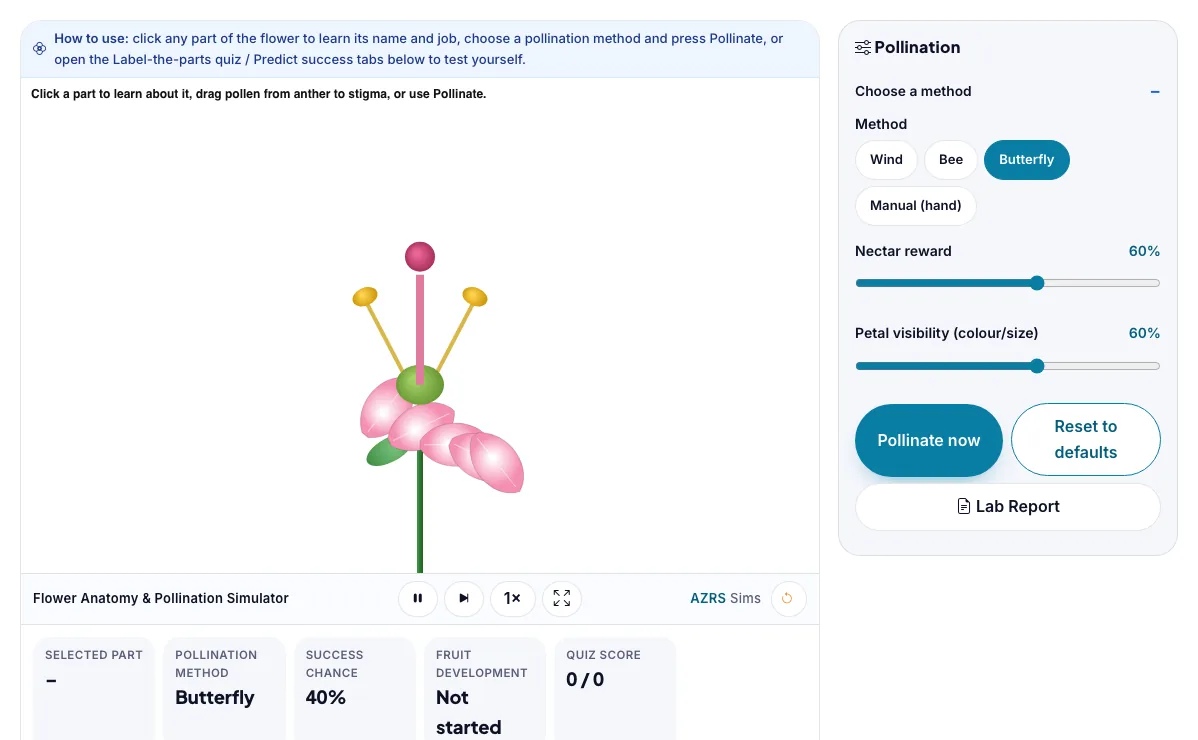
Click a flower's parts to learn stigma, style, ovary, anther, filament, petal and sepal, then choose a pollination method and watch a fruit develop.
- Free to use
- No signup
- Nothing to install
- Runs in your browser
Illustration. Open the tool for the real thing.
See it in action
The Flower Anatomy & Pollination Simulator with sample data entered and the result showing.
What is the Flower Anatomy & Pollination Simulator?
Click a flower's parts to learn stigma, style, ovary, anther, filament, petal and sepal, then choose a pollination method and watch a fruit develop. It runs in your browser, so a change to a setting or a drag on an object shows up at once.
Farmers rent honeybee hives to pollinate almond and fruit orchards, and greenhouse growers hand-pollinate or use bumblebee colonies for tomatoes, because pollination success directly determines fruit yield.
3 steps to your result
Open the tool and follow along. Nothing to install.
What you get
The pistil (stigma, style, ovary) is the female part of the flower; the stamen (anther, filament) is the male part.
Pollination methods differ: wind relies on chance and volume, insects rely on nectar rewards and visible petals, and hand pollination is done deliberately by farmers for high-value crops.
After a pollen grain lands on the stigma, it grows a pollen tube down the style to fertilise an ovule in the ovary.
Click every part of the flower and read its job before pollinating.
Compare the success chance for wind at low wind speed versus a bee visit with high nectar.
Try manual pollination and see why growers hand-pollinate vanilla and some greenhouse crops.
Used for
Pick one to see how it fits.
Teachers
For teachers: project the Flower Anatomy & Pollination Simulator on the board, let students predict the result, then run it together and test this: Compare the success chance for wind at low wind speed versus a bee visit with high nectar. For students: change one thing at a time and write down what changes.
Try it freeHow it compares
A plain look at this tool next to the usual alternative.
| This simulation | Textbook diagram | |
|---|---|---|
| Interactive | Drag, tap and change settings | Fixed picture |
| Install | Nothing to install | Not needed |
| Cost | Free to use | Depends on the book |
Questions people ask
Why do some flowers have bright petals and nectar while others do not?
Insect-pollinated flowers invest in colour, scent and nectar to attract bees and butterflies, while wind-pollinated flowers save that energy since they don't need to attract anyone.
What happens to the ovary after successful pollination?
A pollen tube grows down the style, fertilises an ovule, and this triggers the ovary to swell and ripen into a fruit while the ovule becomes a seed.
Is the Flower Anatomy & Pollination Simulator free to use?
Yes. The Flower Anatomy & Pollination Simulator is free, needs no signup or download and runs in your web browser. It is part of the Botany group of AZRS simulations.
Does the Flower Anatomy & Pollination Simulator work on a phone or tablet?
Yes. The Flower Anatomy & Pollination Simulator takes touch input as well as mouse input, so you can use its 4 adjustable settings with a finger. A larger screen makes the controls and graphs easier to read.
How do I use the Flower Anatomy & Pollination Simulator?
1. In the Flower Anatomy & Pollination Simulator, use the controls to change Method, Wind speed, Nectar reward, Petal visibility (colour/size). The simulation reacts instantly. 2. In the Flower Anatomy & Pollination Simulator, pick an option such as Wind, Bee, Butterfly, Manual (hand) to switch modes or load an example. 3. In the Flower Anatomy & Pollination Simulator, press "Pollinate now" to start, reset or change what is happening. 4. Start with this experiment: Click every part of the flower and read its job before pollinating. Drag any glowing handle, object or slider with your mouse or finger and the Flower Anatomy & Pollination Simulator responds in real time. 5. Change one setting at a time and watch which readout moves, then compare it with this idea: The pistil (stigma, style, ovary) is the female part of the flower; the stamen (anther, filament) is the male part.
More free tools
Related to the Flower Anatomy & Pollination Simulator.
Try the Flower Anatomy & Pollination Simulator now
Click a flower's parts to learn stigma, style, ovary, anther, filament, petal and sepal. Free to use.
Try it free