
Explore the Seed Germination Simulator
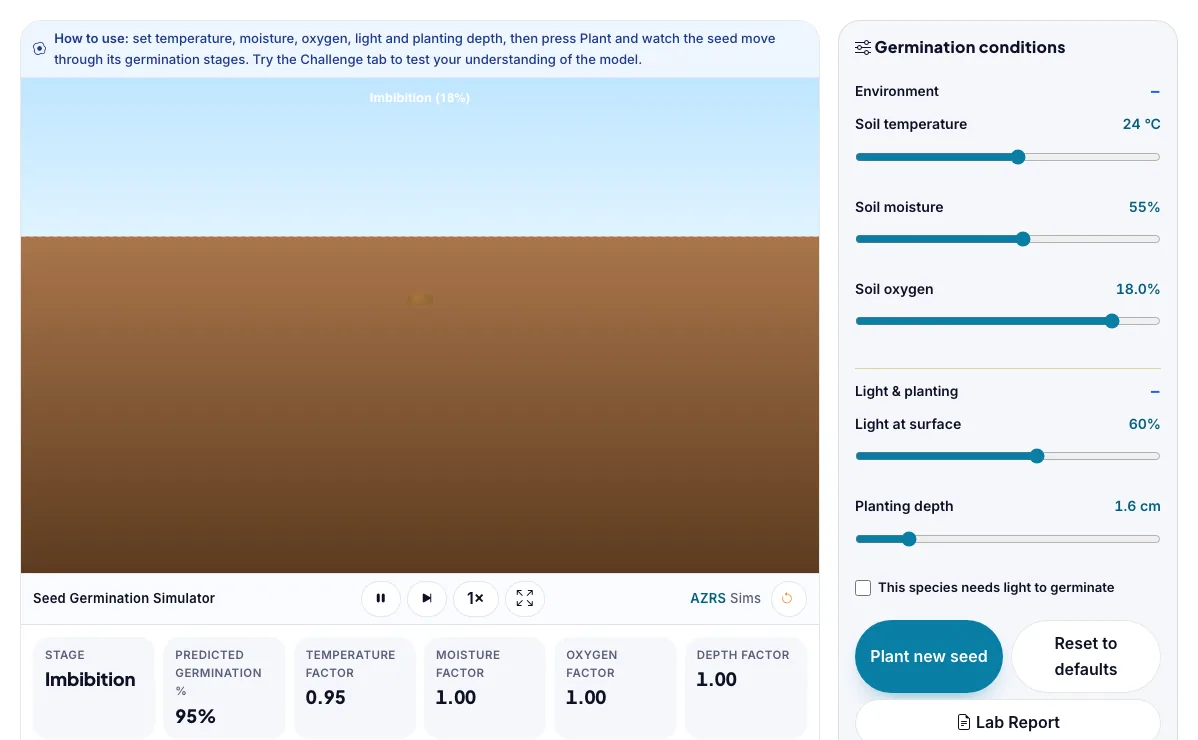
Set temperature, moisture, oxygen, light and planting depth, then watch a seed move through imbibition, radicle, root, shoot and first leaves.
- Free to use
- No signup
- Nothing to install
- Runs in your browser
Illustration. Open the tool for the real thing.
See it in action
The Seed Germination Simulator with sample data entered and the result showing.
What is the Seed Germination Simulator?
Set temperature, moisture, oxygen, light and planting depth, then watch a seed move through imbibition, radicle, root, shoot and first leaves. It runs in your browser, so a change to a setting or a drag on an object shows up at once.
Farmers choose planting dates and depths, and seed companies print germination-rate guarantees on packets, based on exactly this kind of temperature and moisture testing.
3 steps to your result
Open the tool and follow along. Nothing to install.
What you get
Germination temperature follows a cardinal temperature model: too cold or too hot and nothing germinates, with a peak at the optimum temperature.
Seeds need enough moisture to imbibe water and swell, but waterlogged soil cuts off the oxygen they need to respire.
Some species need light to germinate, others are inhibited by it, and most cannot push a shoot up from too deep in the soil.
Run 50 trials at a cold temperature and see how few germinate.
Sweep germination percent versus temperature and find the peak.
Bury the seed at 8 cm and watch the shoot struggle to reach the surface.
Used for
Pick one to see how it fits.
Teachers
For teachers: project the Seed Germination Simulator on the board, let students predict the result, then run it together and test this: Sweep germination percent versus temperature and find the peak. For students: change one thing at a time and write down what changes.
Try it freeHow it compares
A plain look at this tool next to the usual alternative.
| This simulation | Textbook diagram | |
|---|---|---|
| Interactive | Drag, tap and change settings | Fixed picture |
| Install | Nothing to install | Not needed |
| Cost | Free to use | Depends on the book |
Questions people ask
Why is there an optimum temperature for germination rather than 'hotter is always better'?
Germination depends on enzyme activity, which rises with temperature only up to a point before high heat starts to damage the seed's proteins, so the rate falls again past the optimum.
Why does running only a few trials give a different percentage than the theoretical prediction?
Each seed's fate is a random event, so a small sample is affected by chance (sampling noise); running hundreds or thousands of trials brings the result much closer to the true theoretical percentage.
Is the Seed Germination Simulator free to use?
Yes. The Seed Germination Simulator is free, needs no signup or download and runs in your web browser. It is part of the Botany group of AZRS simulations.
Does the Seed Germination Simulator work on a phone or tablet?
Yes. The Seed Germination Simulator takes touch input as well as mouse input, so you can use its 6 adjustable settings with a finger. A larger screen makes the controls and graphs easier to read.
How do I use the Seed Germination Simulator?
1. In the Seed Germination Simulator, use the controls to change Soil temperature, Soil moisture, Soil oxygen, Light at surface, Planting depth, and more. The simulation reacts instantly. 2. In the Seed Germination Simulator, press "Plant new seed" to start, reset or change what is happening. 3. Start with this experiment: Run 50 trials at a cold temperature and see how few germinate. Drag any glowing handle, object or slider with your mouse or finger and the Seed Germination Simulator responds in real time. 4. Change one setting at a time and watch which readout moves, then compare it with this idea: Germination temperature follows a cardinal temperature model: too cold or too hot and nothing germinates, with a peak at the optimum temperature.
More free tools
Related to the Seed Germination Simulator.
Try the Seed Germination Simulator now
Set temperature, moisture, oxygen, light and planting depth, then watch a seed move. Free to use.
Try it free