
Explore the Heat Conduction Through a Wall: Fourier's Law
Change a wall's thickness, area and material, or stack layers of brick and insulation in series, and watch the heat flow. Works on phones and computers.
- Free to use
- No signup
- Nothing to install
- Runs in your browser
Illustration. Open the tool for the real thing.
See it in action
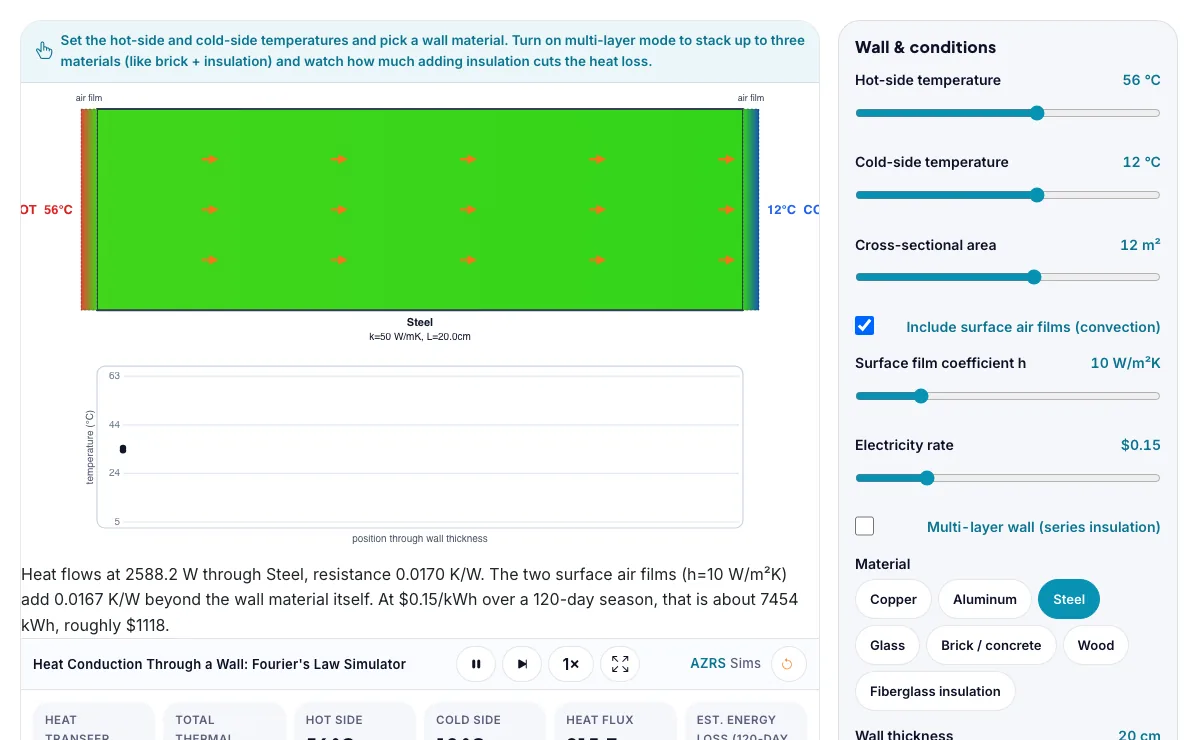
The Heat Conduction Through a Wall: Fourier's Law with sample data entered and the result showing.
What is the Heat Conduction Through a Wall: Fourier's Law?
Change a wall's thickness, area and material, or stack layers of brick and insulation in series, and watch the heat flow and temperature gradient update live using Fourier's law. It runs in your browser, so a change to a setting or a drag on an object shows up at once.
Building insulation, refrigerator and oven walls, pipe lagging, spacecraft thermal protection tiles, and industrial furnace linings are all designed using this same steady-state conduction and thermal-resistance-in-series analysis to control how fast heat is gained or lost.
3 steps to your result
Open the tool and follow along. Nothing to install.
What you get
Steady-state 1D conduction follows Fourier's law: Q = kA(T1-T2)/L, where k is the thermal conductivity of the material, A is the cross-sectional area, and L is the thickness.
Thermal resistance R = L/(kA) plays the same role as electrical resistance: a bigger R means less heat gets through for the same temperature difference.
When layers are stacked (like brick plus insulation), heat has to cross each one in series, so the resistances simply add: R_total = R1 + R2 + R3, and Q = ΔT / R_total.
Set a single copper wall and a single fiberglass wall of the same thickness and area, and compare the heat transfer rate Q.
Turn on multi-layer mode and build a wall of brick plus a thin layer of fiberglass insulation. Watch how much Q drops compared with brick alone.
With multi-layer mode on, make the insulation layer thicker and thinner and see how much of the total resistance it controls even when it is much thinner than the brick layer.
Used for
Pick one to see how it fits.
Engineering learners
Engineering and technology students, makers, robotics clubs and teachers of design and technology.
Try it freeTeachers
For teachers: project the Heat Conduction Through a Wall: Fourier's Law Simulator on the board, let students predict the result, then run it together and test this: Turn on multi-layer mode and build a wall of brick plus a thin layer of fiberglass insulation. Watch how much Q drops compared with brick alone. For students: change one thing at a time and write down what changes.
Try it freeHow it compares
A plain look at this tool next to the usual alternative.
| This simulation | Textbook diagram | |
|---|---|---|
| Interactive | Drag, tap and change settings | Fixed picture |
| Install | Nothing to install | Not needed |
| Cost | Free to use | Depends on the book |
Questions people ask
Why does adding insulation cut heat loss so much more than adding more brick or concrete?
Because insulation has a much lower thermal conductivity, so a thin insulation layer already adds a large thermal resistance. Since resistances in series simply add, that one thin low-k layer can dominate the total resistance and choke off most of the heat flow, while a thick layer of a good conductor barely slows it down.
What is the difference between thermal conductivity (k) and thermal resistance (R)?
Thermal conductivity k is a property of the material itself (how easily it conducts heat, in W/m·K). Thermal resistance R = L/(kA) also depends on how thick and how wide the actual piece of material is, so the same material can have a high or low resistance depending on its shape.
Why is the temperature line straight through each layer but bends at the layer boundaries?
Within a single uniform material at steady state, the temperature drops at a constant rate, so it is a straight line. At the boundary between two different materials the slope has to change because a different k means a different temperature drop per unit of thickness for the same heat flow.
What is the surface air film (convection) toggle doing?
It adds a small extra resistance, R = 1/(hA), on the hot and cold faces of the wall to represent the still air that clings to any real surface, in series with the wall's own conduction resistance. With it on, R_total = R_film,hot + R_wall + R_film,cold, so Q is a little lower than pure conduction alone would predict, which matches how real buildings actually behave.
How is the energy-cost estimate calculated?
It multiplies the steady heat-loss rate Q by an assumed 120-day (2,880 hour) heating season to get kWh, then multiplies by the editable electricity rate to get an approximate cost. It is meant as a rough, order-of-magnitude teaching estimate, not a real utility-bill prediction, since real weather and indoor temperatures vary.
More free tools
Related to the Heat Conduction Through a Wall: Fourier's Law.
Try the Heat Conduction Through a Wall: Fourier's Law now
Change a wall's thickness, area and material, or stack layers of brick and insulation in. Free to use.
Try it free