
Explore the Transformer Simulator: Turns Ratio, Losses &
Build a step-up or step-down transformer, add winding resistance and core loss, and watch efficiency change as you load it. Works on phones and computers.
- Free to use
- No signup
- Nothing to install
- Runs in your browser
Illustration. Open the tool for the real thing.
See it in action
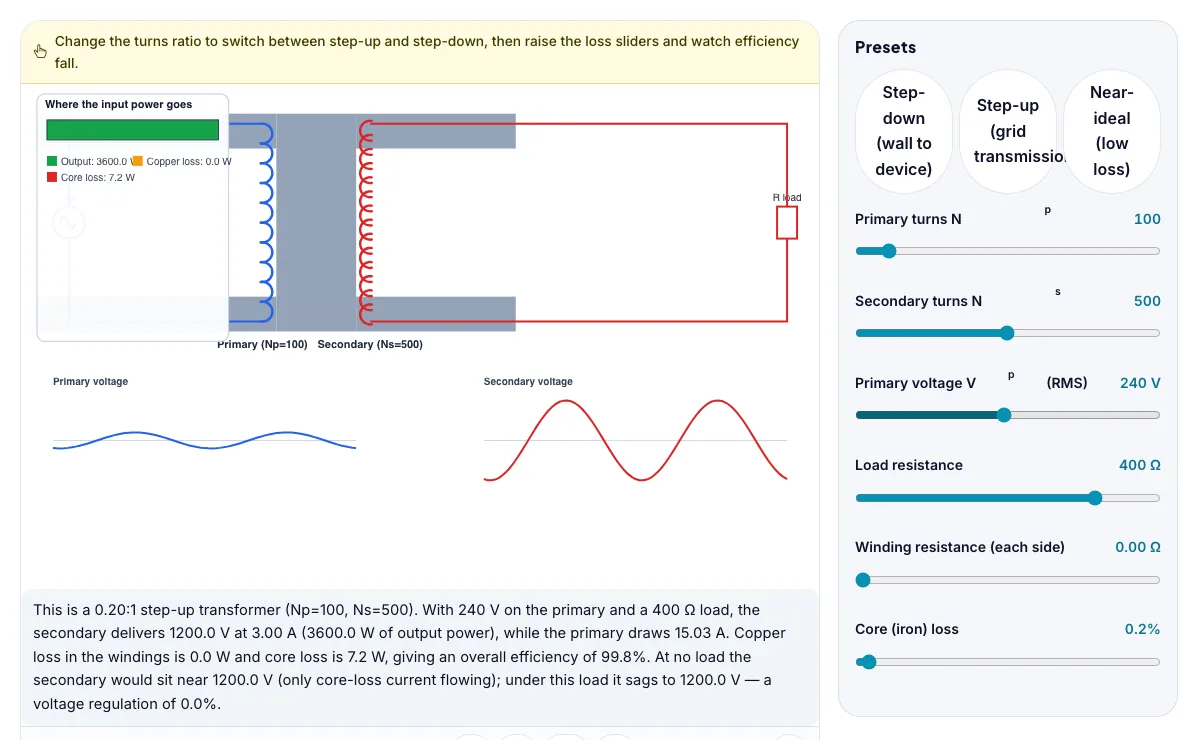
The Transformer Simulator: Turns Ratio, Losses & with sample data entered and the result showing.
What is the Transformer Simulator: Turns Ratio, Losses &?
Build a step-up or step-down transformer, add winding resistance and core loss, and watch efficiency change as you load it. It runs in your browser, so a change to a setting or a drag on an object shows up at once.
Transformers step voltage up for long-distance power transmission and down again for homes and factories, and smaller versions live inside phone chargers, doorbell transformers, welders, and the isolation transformers used in hospitals and labs.
3 steps to your result
Open the tool and follow along. Nothing to install.
What you get
An ideal transformer's secondary voltage is set only by the turns ratio: Vs = Vp×(Ns/Np).
A transformer with more secondary turns than primary turns (Ns > Np) is a step-up transformer; fewer secondary turns (Ns < Np) makes it step-down.
Real windings have resistance, so some voltage is lost to I²R heating in the copper, and the secondary terminal voltage sags a little below the ideal value under load.
Set Ns greater than Np and confirm the readout switches to step-up with a raised secondary voltage.
Push the winding-resistance slider up and watch the secondary voltage sag below the ideal Vp×(Ns/Np) value.
Raise the core-loss slider with a light load and see efficiency fall even though the copper loss barely changes.
Used for
Pick one to see how it fits.
Engineering learners
Engineering and technology students, makers, robotics clubs and teachers of design and technology.
Try it freeTeachers
For teachers: project the Transformer Simulator: Turns Ratio, Losses & Efficiency on the board, let students predict the result, then run it together and test this: Push the winding-resistance slider up and watch the secondary voltage sag below the ideal Vp×(Ns/Np) value. For students: change one thing at a time and write down what changes.
Try it freeHow it compares
A plain look at this tool next to the usual alternative.
| This simulation | Textbook diagram | |
|---|---|---|
| Interactive | Drag, tap and change settings | Fixed picture |
| Install | Nothing to install | Not needed |
| Cost | Free to use | Depends on the book |
Questions people ask
Why do power grids transmit electricity at high voltage?
Transmitting the same power at a higher voltage means a lower current, and since resistive loss grows with the square of current (I²R), high-voltage transmission loses much less energy to heat in the lines. A step-up transformer raises the voltage for the transmission line and a step-down transformer lowers it again near homes.
Why isn't a real transformer 100% efficient?
Two things eat into the power: copper loss (I²R heating in the primary and secondary windings, which grows with load) and core loss (energy spent magnetizing and demagnetizing the iron core every cycle, which is present even at no load).
How do you tell if a transformer is step-up or step-down?
Compare the turns: if the secondary has more turns than the primary (Ns > Np) it is step-up (raises voltage, lowers current); if the secondary has fewer turns (Ns < Np) it is step-down (lowers voltage, raises current).
Is the Transformer Simulator: Turns Ratio, Losses & Efficiency free to use?
Yes. The Transformer Simulator: Turns Ratio, Losses & Efficiency is free, needs no signup or download and runs in your web browser. It is part of the Engineering group of AZRS simulations.
Does the Transformer Simulator: Turns Ratio, Losses & Efficiency work on a phone or tablet?
Yes. The Transformer Simulator: Turns Ratio, Losses & Efficiency takes touch input as well as mouse input, so you can use its 6 adjustable settings with a finger. A larger screen makes the controls and graphs easier to read.
More free tools
Related to the Transformer Simulator: Turns Ratio, Losses &.
Try the Transformer Simulator: Turns Ratio, Losses & now
Build a step-up or step-down transformer, add winding resistance and core loss, and watch. Free to use.
Try it free