
Explore the Plant Transpiration Laboratory
Control humidity, temperature, wind and stomatal aperture in a sealed chamber, zoom on the stomata, and measure the transpiration rate live.
- Free to use
- No signup
- Nothing to install
- Runs in your browser
Illustration. Open the tool for the real thing.
See it in action
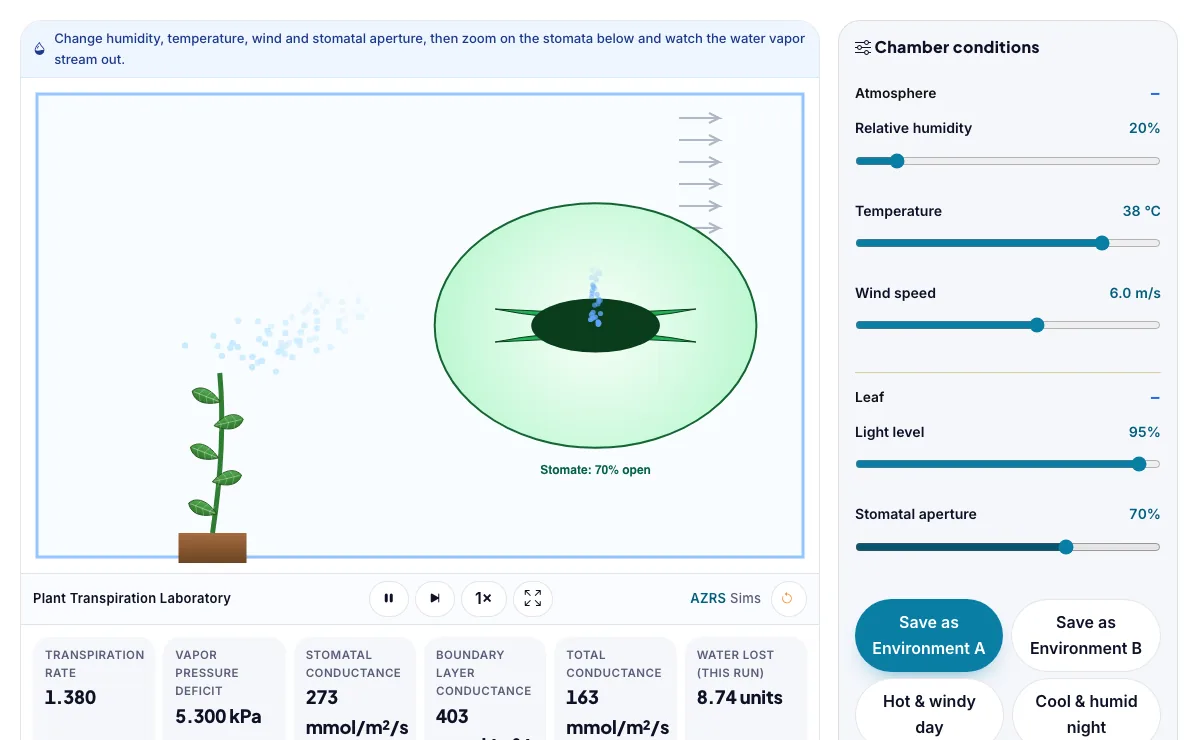
The Plant Transpiration Laboratory with sample data entered and the result showing.
What is the Plant Transpiration Laboratory?
Control humidity, temperature, wind and stomatal aperture in a sealed chamber, zoom on the stomata, and measure the transpiration rate live. It runs in your browser, so a change to a setting or a drag on an object shows up at once.
Farmers schedule irrigation and greenhouse ventilation around exactly this vapor-pressure-deficit and wind effect to avoid wilting crops on hot, dry, windy days.
3 steps to your result
Open the tool and follow along. Nothing to install.
What you get
Transpiration is driven by the vapor pressure deficit (VPD): the drier and hotter the air, the harder it pulls water vapor out of the leaf.
Wind thins the still air layer clinging to a leaf, raising boundary-layer conductance and speeding up water loss.
Stomata are a trade-off: opening them lets CO₂ in for photosynthesis but also lets water vapor escape.
Try the hot and windy preset, then the cool and humid preset, and compare readouts.
Save two different environments as A and B and compare their water loss on the same bar chart.
Close the stomata to 10% and see how far the rate drops despite high VPD.
Used for
Pick one to see how it fits.
Teachers
For teachers: project the Plant Transpiration Laboratory on the board, let students predict the result, then run it together and test this: Save two different environments as A and B and compare their water loss on the same bar chart. For students: change one thing at a time and write down what changes.
Try it freeHow it compares
A plain look at this tool next to the usual alternative.
| This simulation | Textbook diagram | |
|---|---|---|
| Interactive | Drag, tap and change settings | Fixed picture |
| Install | Nothing to install | Not needed |
| Cost | Free to use | Depends on the book |
Questions people ask
What is vapor pressure deficit?
It is the difference between the air's saturation vapor pressure at the current temperature and its actual vapor pressure at the current humidity - the 'drying power' of the air.
Why does wind increase transpiration even without changing humidity?
Wind sweeps away the humid air sitting right at the leaf surface, steepening the vapor gradient and thinning the boundary layer that would otherwise trap moisture.
Is the Plant Transpiration Laboratory free to use?
Yes. The Plant Transpiration Laboratory is free, needs no signup or download and runs in your web browser. It is part of the Botany group of AZRS simulations.
Does the Plant Transpiration Laboratory work on a phone or tablet?
Yes. The Plant Transpiration Laboratory takes touch input as well as mouse input, so you can use its 5 adjustable settings with a finger. A larger screen makes the controls and graphs easier to read.
How do I use the Plant Transpiration Laboratory?
1. In the Plant Transpiration Laboratory, use the controls to change Relative humidity, Temperature, Wind speed, Light level, Stomatal aperture. The simulation reacts instantly. 2. In the Plant Transpiration Laboratory, press "Save as Environment A", "Save as Environment B", "Hot & windy day", "Cool & humid night" to start, reset or change what is happening. 3. Start with this experiment: Try the hot and windy preset, then the cool and humid preset, and compare readouts. Drag any glowing handle, object or slider with your mouse or finger and the Plant Transpiration Laboratory responds in real time. 4. Change one setting at a time and watch which readout moves, then compare it with this idea: Transpiration is driven by the vapor pressure deficit (VPD): the drier and hotter the air, the harder it pulls water vapor out of the leaf.
More free tools
Related to the Plant Transpiration Laboratory.
Try the Plant Transpiration Laboratory now
Control humidity, temperature, wind and stomatal aperture in a sealed chamber, zoom on. Free to use.
Try it free