
Explore the Stress-Strain / Tensile Test Simulator
Pull a virtual specimen of steel, aluminum, copper or a brittle polymer and watch the live stress-strain curve trace through elastic, yielding.
- Free to use
- No signup
- Nothing to install
- Runs in your browser
Illustration. Open the tool for the real thing.
See it in action
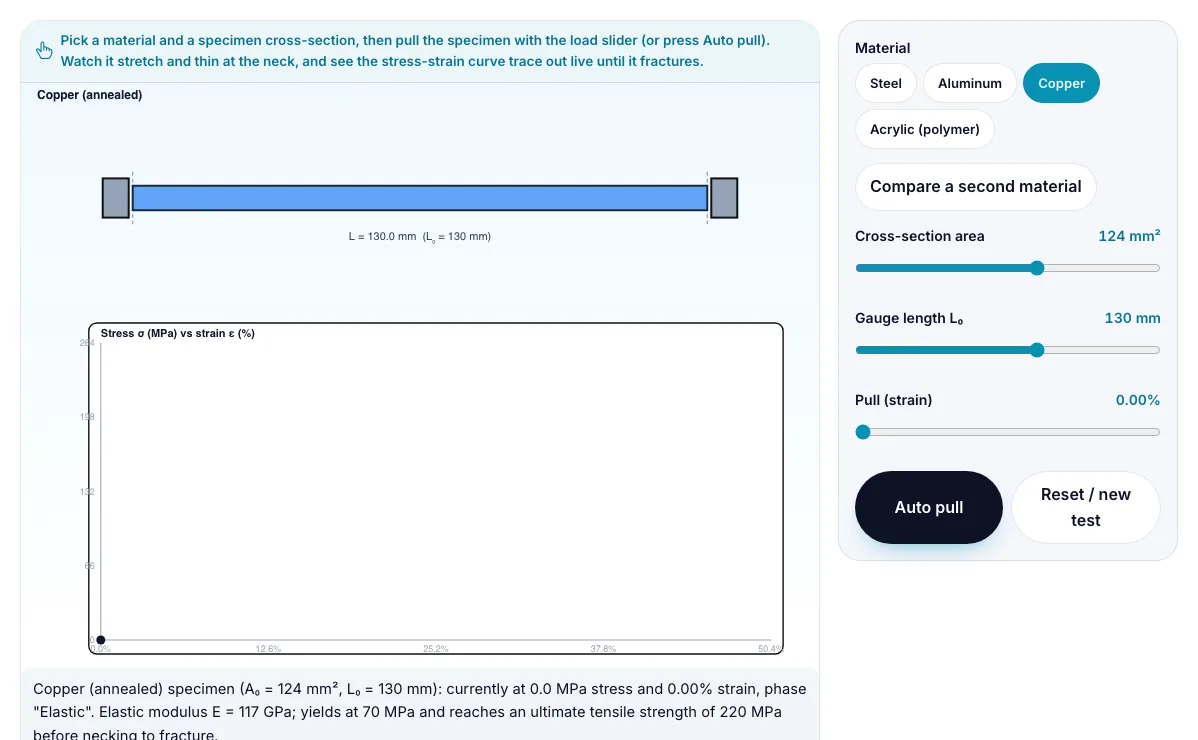
The Stress-Strain / Tensile Test Simulator with sample data entered and the result showing.
What is the Stress-Strain / Tensile Test Simulator?
Pull a virtual specimen of steel, aluminum, copper or a brittle polymer and watch the live stress-strain curve trace through elastic, yielding, necking and fracture. It runs in your browser, so a change to a setting or a drag on an object shows up at once.
Tensile testing is the standard way engineers qualify materials for bridges, pressure vessels, aircraft structures, fasteners and medical implants, and it is exactly how the material property tables used in beam, shaft and truss design (elsewhere on this site) are actually measured in a lab.
3 steps to your result
Open the tool and follow along. Nothing to install.
What you get
Engineering stress (σ = F / A₀) and engineering strain (ε = ΔL / L₀) are both measured against the specimen's original dimensions, which is why stress appears to drop during necking even though the material is actually getting stronger locally.
The straight-line elastic region obeys Hooke's law (σ = E·ε); its slope is the elastic modulus E, a measure of stiffness that is completely separate from strength.
The yield point marks where permanent (plastic) deformation begins — beyond it, the specimen will not return to its original length when unloaded.
Pull the acrylic polymer specimen and compare how little it stretches before fracture against steel or copper.
Use Auto pull on copper and watch how far it necks before it finally breaks — copper is one of the most ductile common engineering metals.
Increase the cross-section area and note that the stress-strain curve (a material property) does not change, even though the force needed to reach the same stress goes up.
Used for
Pick one to see how it fits.
Engineering learners
Engineering and technology students, makers, robotics clubs and teachers of design and technology.
Try it freeTeachers
For teachers: project the Stress-Strain / Tensile Test Simulator on the board, let students predict the result, then run it together and test this: Use Auto pull on copper and watch how far it necks before it finally breaks — copper is one of the most ductile common engineering metals. For students: change one thing at a time and write down what changes.
Try it freeHow it compares
A plain look at this tool next to the usual alternative.
| This simulation | Textbook diagram | |
|---|---|---|
| Interactive | Drag, tap and change settings | Fixed picture |
| Install | Nothing to install | Not needed |
| Cost | Free to use | Depends on the book |
Questions people ask
Why does the stress-strain curve go down after the peak (UTS) for ductile materials?
After the ultimate tensile strength, deformation localizes into a "neck" — a narrow region that thins faster than the rest of the specimen. The true stress at that neck keeps rising, but engineering stress is calculated using the original cross-section area A₀, which no longer matches the actual (smaller) area carrying the load, so the calculated engineering stress falls even as the material is still working harder locally.
What is the real difference between a ductile and a brittle material on this graph?
A ductile material (like steel, aluminum or copper) yields and stretches a lot — often 10-45% strain — absorbing energy before fracture. A brittle material (like the acrylic polymer here) has very little plastic region: it deforms almost elastically right up until it suddenly fractures, typically at only a few percent strain, giving little warning before failure.
Why do steel and aluminum have such different elastic moduli even though both are metals?
Elastic modulus comes from the strength of atomic bonding and crystal structure, not from alloying for strength. Steel's iron-based structure has stronger, stiffer atomic bonds than aluminum's, giving it roughly triple the elastic modulus (about 200 GPa vs 69 GPa), even though some aluminum alloys can have a similar or higher yield strength than mild steel.
Is the Stress-Strain / Tensile Test Simulator free to use?
Yes. The Stress-Strain / Tensile Test Simulator is free, needs no signup or download and runs in your web browser. It is part of the Engineering group of AZRS simulations.
Does the Stress-Strain / Tensile Test Simulator work on a phone or tablet?
Yes. The Stress-Strain / Tensile Test Simulator takes touch input as well as mouse input, so you can use its 5 adjustable settings with a finger. A larger screen makes the controls and graphs easier to read.
More free tools
Related to the Stress-Strain / Tensile Test Simulator.
Try the Stress-Strain / Tensile Test Simulator now
Pull a virtual specimen of steel, aluminum, copper or a brittle polymer and watch the. Free to use.
Try it free