
Explore the Electrical Power Transformer & Transmission
Step a generator's voltage up through an ideal transformer, send the power down a resistive transmission line, and watch the current.
- Free to use
- No signup
- Nothing to install
- Runs in your browser
Illustration. Open the tool for the real thing.
See it in action
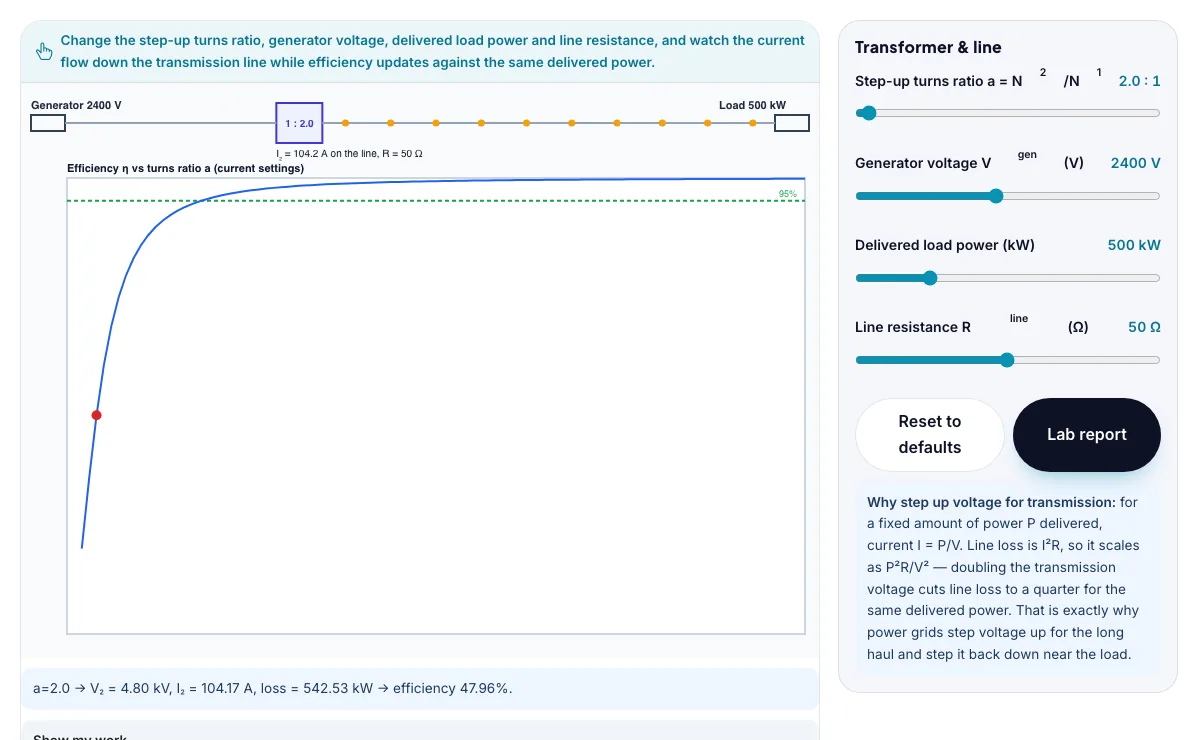
The Electrical Power Transformer & Transmission with sample data entered and the result showing.
What is the Electrical Power Transformer & Transmission?
Step a generator's voltage up through an ideal transformer, send the power down a resistive transmission line, and watch the current, I²R line loss and transmission efficiency all update live against the same delivered power. It runs in your browser, so a change to a setting or a drag on an object shows up at once.
Electric utilities size exactly this transformer turns ratio and conductor resistance trade-off for every transmission and distribution line, since even a fraction of a percent of I²R loss over a large power grid adds up to enormous wasted energy and cost.
3 steps to your result
Open the tool and follow along. Nothing to install.
What you get
An ideal transformer relates primary and secondary voltage and current by the turns ratio: V2 = a·V1 and I1 = a·I2, so stepping voltage up by a factor of a steps current down by the same factor for the same transmitted power.
For a fixed amount of delivered power P, the current needed is I = P/V, so line loss I^2*R scales as P^2*R/V^2 - doubling the transmission voltage cuts line loss to one quarter for the same delivered power.
This is exactly why power grids step voltage up to tens or hundreds of kilovolts for long-distance transmission and step it back down near the load: the same power moves with far less current, and far less I^2R loss, at higher voltage.
Try the 95% efficiency challenge by raising the turns ratio at the default settings.
Try the below-1%-loss challenge by raising generator voltage or lowering line resistance without touching the turns ratio.
Watch the current particles on the transmission line slow down as you raise the turns ratio.
Used for
Pick one to see how it fits.
Engineering learners
Engineering and technology students, makers, robotics clubs and teachers of design and technology.
Try it freeTeachers
For teachers: project the Electrical Power Transformer & Transmission Line Lab on the board, let students predict the result, then run it together and test this: Try the below-1%-loss challenge by raising generator voltage or lowering line resistance without touching the turns ratio. For students: change one thing at a time and write down what changes.
Try it freeHow it compares
A plain look at this tool next to the usual alternative.
| This simulation | Textbook diagram | |
|---|---|---|
| Interactive | Drag, tap and change settings | Fixed picture |
| Install | Nothing to install | Not needed |
| Cost | Free to use | Depends on the book |
Questions people ask
Why does doubling the transmission voltage cut line loss to a quarter instead of half, for the same delivered power?
For fixed delivered power P, the current is I = P/V, so doubling V halves the current; but line loss is I^2*R, and squaring a halved current gives one quarter of the original loss - the loss depends on the square of current, not current itself, which is why raising transmission voltage is such an effective lever.
Why can't you just always crank the turns ratio up to make transmission loss negligible?
In this simulation there is no upper limit shown, but real transformers, insulation and switchgear all become more expensive and physically larger at higher voltages, and there is a practical ceiling where corona losses, insulation breakdown risk and equipment cost outweigh the shrinking I^2R savings - so real grids pick a transmission voltage that balances loss against these other costs.
Is the Electrical Power Transformer & Transmission Line Lab free to use?
Yes. The Electrical Power Transformer & Transmission Line Lab is free, needs no signup or download and runs in your web browser. It is part of the Engineering group of AZRS simulations.
Does the Electrical Power Transformer & Transmission Line Lab work on a phone or tablet?
Yes. The Electrical Power Transformer & Transmission Line Lab takes touch input as well as mouse input, so you can use its 4 adjustable settings with a finger. A larger screen makes the controls and graphs easier to read.
How do I use the Electrical Power Transformer & Transmission?
1. In the Electrical Power Transformer & Transmission Line Lab, use the controls to change Step-up turns ratio a = N2/N1, Generator voltage Vgen (V), Delivered load power (kW), Line resistance Rline (Ω). The simulation reacts instantly. 2. Start with this experiment: Try the 95% efficiency challenge by raising the turns ratio at the default settings. Drag any glowing handle, object or slider with your mouse or finger and the Electrical Power Transformer & Transmission Line Lab responds in real time. 3. Change one setting at a time and watch which readout moves, then compare it with this idea: An ideal transformer relates primary and secondary voltage and current by the turns ratio: V2 = a·V1 and I1 = a·I2, so stepping voltage up by a factor of a steps current down by the same factor for the same transmitted power.
More free tools
Related to the Electrical Power Transformer & Transmission.
Try the Electrical Power Transformer & Transmission now
Step a generator's voltage up through an ideal transformer, send the power down a. Free to use.
Try it free