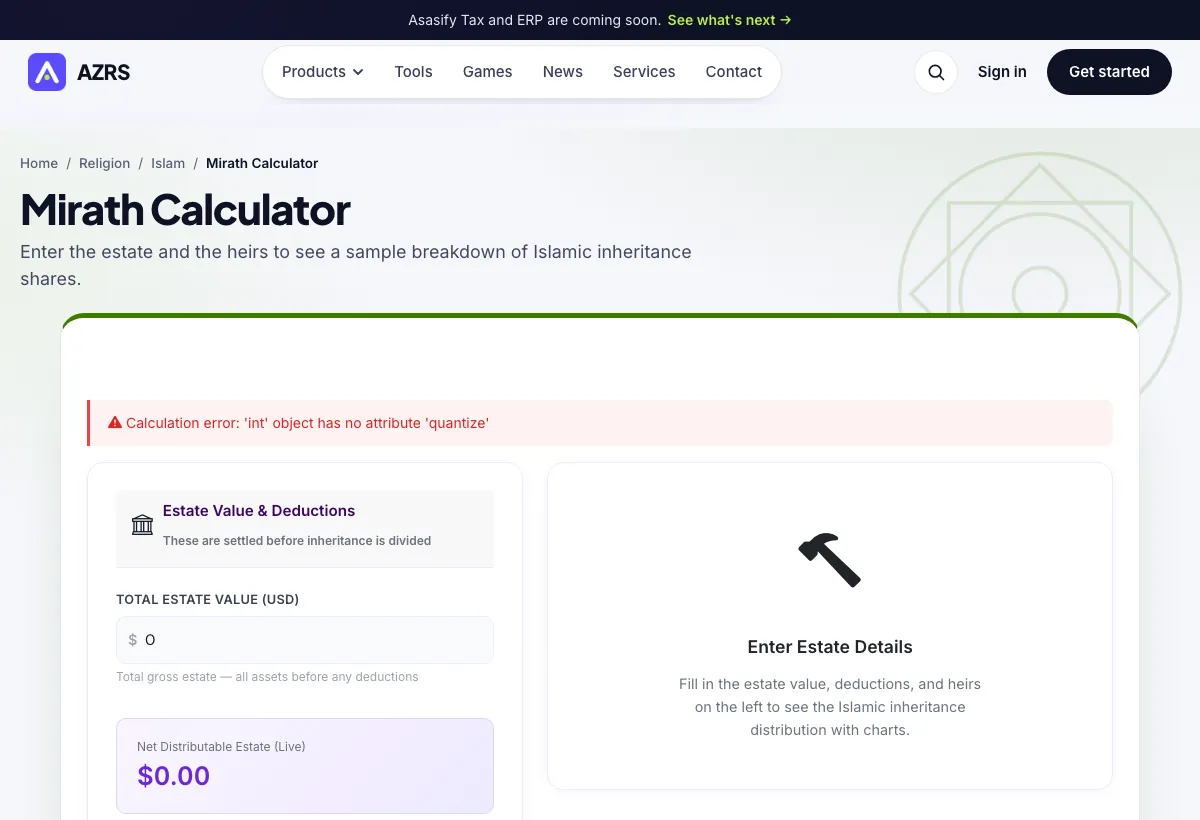
Mirath Calculator
Enter the estate and the heirs to see a sample breakdown of Islamic inheritance shares.
This calculator is educational and covers common scenarios. For complex inheritance situations, consult a qualified Islamic scholar or Faraid specialist.
Guidance only. Confirm any religious ruling with a qualified scholar or your local mosque.
About the Mirath Calculator tool
Mirath is the Islamic law of inheritance, also called Faraid. The Quran sets out fixed shares for certain heirs, and the remaining part goes to the residuary heirs. Before anything is shared, the funeral costs and debts are paid, and then any valid bequest of up to one third.
This calculator follows that order. You enter the value of the estate, the costs and debts, any bequest, and tick the heirs who are living. The page then shows a sample breakdown of the shares and a chart, and you can print the report.
Inheritance is serious and every family situation is different. Schools of thought differ on some cases, local law also applies, and a missing detail can change a share. This page is an educational sample only and is never a ruling on your family. Take the result to a qualified scholar or your local Islamic authority before dividing any estate.
How to use it
Enter the estate. Add the total value of what the person left behind, in one currency.
Add costs, debts and a bequest. Enter funeral costs and debts. If there is a valid bequest, enter it. It cannot be more than one third of the net estate.
Select the living heirs. Tick each relative who is alive, such as spouse, children, parents and siblings. Leave the others unticked.
Calculate. Press the calculate button to see each share as a fraction and as an amount.
Review with a scholar. Print or save the report and go through it with a qualified scholar or your local authority.
A simple example
Net estate: 90,000
Shares are shown per heir as fractions and amounts
Confirm the result with a qualified scholar
Tips for good results
- Gather the death certificate, a list of assets and a list of debts before you start.
- Use one currency, and value property at the current fair price.
- Tick only heirs who are alive at the time of death.
- Ask about local law too, since a court may require a legal process for the estate.
Common mistakes
- Sharing the estate before paying funeral costs and debts.
- Making a bequest to a legal heir or above one third without the heirs' consent.
- Ticking heirs who have died, or leaving out living ones.
- Taking the sample result as a final ruling for a real family.
Common questions
What does Faraid mean?
Faraid means the fixed shares. It is the system of fixed and residuary shares set out in the Quran and the Sunnah for dividing an estate.
What is taken out before the shares?
Funeral costs and debts are paid first, then a valid bequest of up to one third of the net estate, and then the rest is shared among the heirs.
Why can the result differ from my scholar?
Schools of thought differ on some cases, and a family may have details this page cannot capture. The scholar's answer for your case is the one to follow.
Can I leave a bequest to an heir?
A bequest is usually for someone who is not already an heir. A bequest to an heir normally needs the agreement of the other heirs. Ask a scholar.
Does this replace a will or a lawyer?
No. It does not make a legal document. Speak to a qualified scholar and, where needed, a lawyer in your country.
More Islam tools
See Free Islamic Inheritance (Mirath / Faraid) Calculator in action
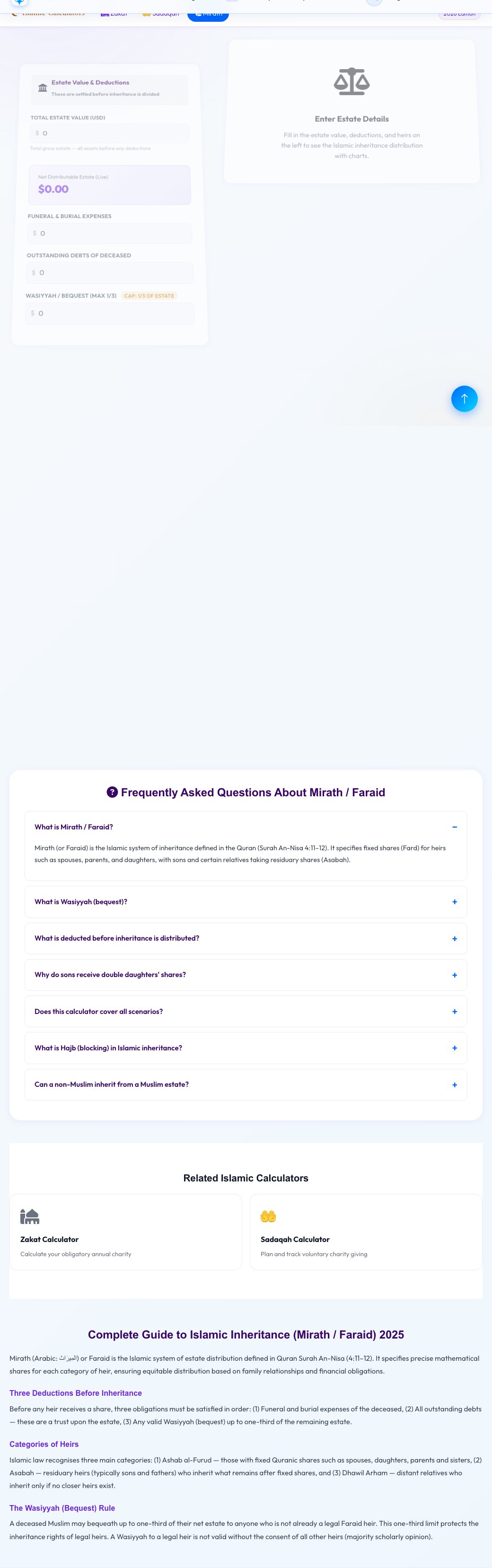
Free Islamic Inheritance (Mirath / Faraid) Calculator
Calculate Islamic inheritance distribution according to the Quranic fixed shares (Fard) and residuary shares (Asabah) system, per Surah An-Nisa 4:11-12. Enter the surviving heirs — spouse, children, parents, grandparents and siblings — and the net estate value, and the calculator distributes shares to each heir automatically, handling common Hajb (blocking) rules.
Before distribution, the calculator settles obligations in the correct order: funeral expenses, then outstanding debts, then Wasiyyah (a bequest of up to one-third of the estate to non-heirs), leaving the net distributable estate that the Quranic shares are then applied to.
Use it in 4 steps
Enter the net estate value.
Select which heirs survived: spouse, children, parents, grandparents, siblings.
Enter any funeral expenses, debts and Wasiyyah bequest.
Review the calculated share and amount for each heir.
Key features
Full Fard and Asabah share calculation
Applies Quranic fixed and residuary shares for all standard heir types.
Automatic Wasiyyah cap
Correctly caps any bequest at the maximum one-third of the net estate.
Hajb (blocking) handling
Automatically applies common blocking rules, such as a father blocking a grandfather.
Full breakdown by heir
See each heir's exact share and amount, not just a total distribution.
A real example, step by step
An estate of $300,000 with a surviving wife, one son and one daughter: after debts and expenses, the wife receives her fixed 1/8 share, and the remainder is split between the son and daughter in a 2:1 ratio as Asabah (residuary heirs).
Who uses this tool
Families settling an estate
Get an accurate starting breakdown of Islamic inheritance shares for all standard heirs.
Anyone learning Faraid
See exactly how Fard and Asabah shares are calculated for a real scenario.
Estate planners
Check a distribution scenario before finalizing a will or discussing with heirs.
Tips for the best results
- Settle funeral expenses, debts, and Wasiyyah in that exact order before any heir share is calculated — this calculator does it automatically, but the order matters.
- A Wasiyyah bequest to a legal Faraid heir isn't valid without the consent of all other heirs — keep any bequest to non-heirs and within the one-third cap.
- Hajb (blocking) rules matter: a father blocks a grandfather, and sons or a father can block full brothers — verify complex family structures with a knowledgeable scholar.
- Use this as a starting calculation for family discussion, not a final legal document — complex estates should be reviewed by a qualified Islamic scholar or lawyer.
Common mistakes to avoid
- Distributing the estate before settling debts, funeral costs and Wasiyyah in the correct order.
- Exceeding the one-third cap on Wasiyyah bequests to non-heirs.
- Missing a Hajb (blocking) rule in a complex family structure, leading to an incorrect distribution.
Frequently asked questions
What is Mirath (Faraid) in Islam?
The Islamic system of inheritance distribution prescribed in the Quran (Surah An-Nisa 4:11-12), defining precise fractions for legal heirs including spouse, children, parents and siblings.
What is the Wasiyyah (bequest) rule?
A Muslim may bequeath up to one-third of their net estate to non-heirs; this calculator automatically caps any entered Wasiyyah at that one-third maximum.
Who are the primary heirs in Islamic inheritance?
Spouse, children, parents and full siblings. The Quran assigns fixed fractions (Fard) to some heirs and residuary shares (Asabah) to others, primarily sons and fathers.
What deductions happen before distribution?
In order: funeral and burial expenses, all outstanding debts, then Wasiyyah up to one-third of what remains. The net amount after these is what's distributed to heirs.
What is Hajb (blocking)?
The exclusion of one heir because a closer heir exists — for example, a father blocks a grandfather, and sons or a father can block full brothers. This calculator handles the most common Hajb scenarios.
Is this Mirath calculator free?
Yes, free with no signup, and it should be used as a helpful starting point, not a substitute for a qualified scholar on complex estates.
Free, fast and private by design
No signup, no watermark. New AZRS tools are added every week.