
Explore the Ozone Layer & UV Radiation Lab
Run a simplified Chapman cycle: balance ozone production against natural and CFC-driven catalytic destruction, and watch surface UV respond.
- Free to use
- No signup
- Nothing to install
- Runs in your browser
Illustration. Open the tool for the real thing.
See it in action
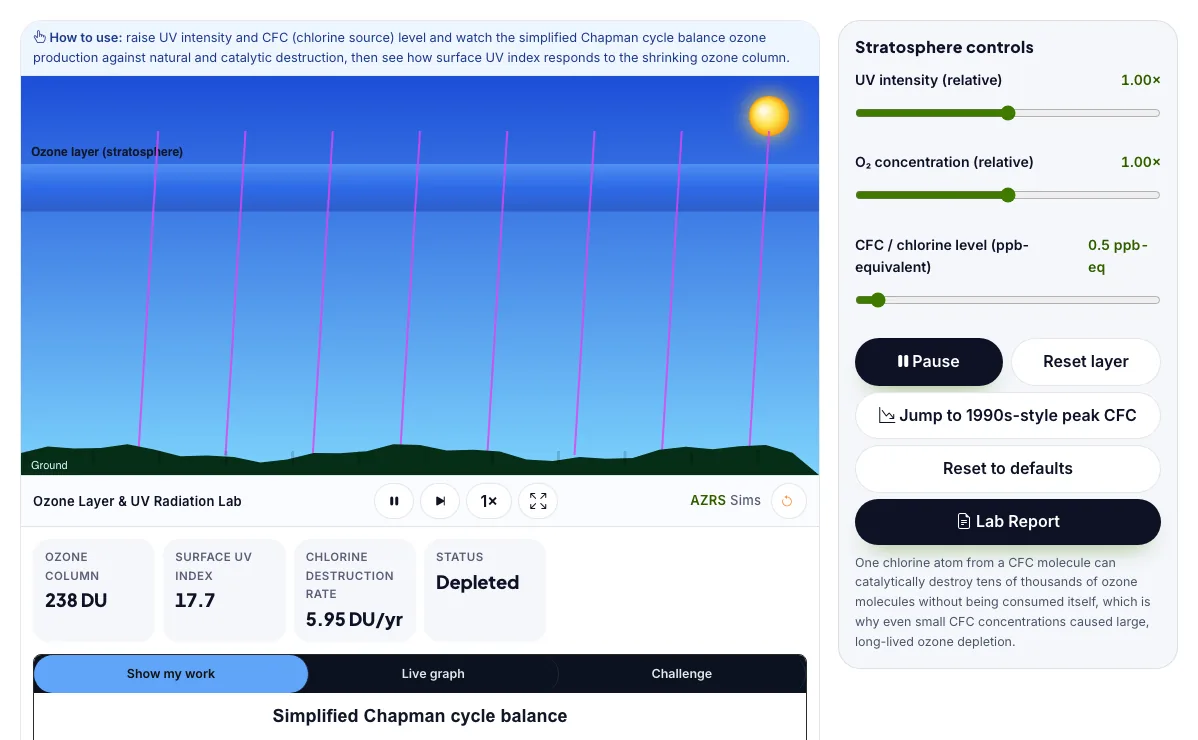
The Ozone Layer & UV Radiation Lab with sample data entered and the result showing.
What is the Ozone Layer & UV Radiation Lab?
Run a simplified Chapman cycle: balance ozone production against natural and CFC-driven catalytic destruction, and watch surface UV respond. It runs in your browser, so a change to a setting or a drag on an object shows up at once.
Atmospheric scientists used exactly this kind of Chapman-cycle and chlorine-catalysis modeling to predict and later confirm the Antarctic ozone hole, leading to the 1987 Montreal Protocol banning CFCs.
3 steps to your result
Open the tool and follow along. Nothing to install.
What you get
Ozone is continuously created when UV light splits O₂ into single oxygen atoms that combine with more O₂ to form O₃ - part of the Chapman cycle.
Ozone is also naturally destroyed when UV light splits it back into O₂ and O, which is itself part of what makes the ozone layer such an effective UV shield.
CFCs release chlorine atoms high in the stratosphere that catalytically destroy ozone - each chlorine atom can break down tens of thousands of ozone molecules without being consumed, so small CFC amounts cause outsized damage.
Push CFC level high and run time forward until an ozone hole (below 220 DU) opens.
From a depleted state, cut CFC to near zero and run time forward to watch recovery.
Raise UV intensity alone (no CFC) and see production and natural destruction both rise together.
Used for
Pick one to see how it fits.
Environmental Science learners
Students, teachers and curious learners of all ages.
Try it freeTeachers
For teachers: project the Ozone Layer & UV Radiation Lab on the board, let students predict the result, then run it together and test this: From a depleted state, cut CFC to near zero and run time forward to watch recovery. For students: change one thing at a time and write down what changes.
Try it freeHow it compares
A plain look at this tool next to the usual alternative.
| This simulation | Textbook diagram | |
|---|---|---|
| Interactive | Drag, tap and change settings | Fixed picture |
| Install | Nothing to install | Not needed |
| Cost | Free to use | Depends on the book |
Questions people ask
Why can a small amount of CFCs destroy so much ozone?
Chlorine released from CFCs acts as a catalyst: it destroys an ozone molecule but is regenerated in the process (Cl + O3 → ClO + O2, then ClO reactions release Cl again), letting a single chlorine atom destroy tens of thousands of ozone molecules before it is finally removed from the stratosphere.
Why did the ozone layer only start recovering after the Montreal Protocol banned CFCs, rather than immediately?
CFCs are extremely long-lived and take decades to break down and clear from the stratosphere even after emissions stop, so the chlorine they already released kept destroying ozone for years, and the ozone column only slowly climbed back once new chlorine input was cut off.
Is the Ozone Layer & UV Radiation Lab free to use?
Yes. The Ozone Layer & UV Radiation Lab is free, needs no signup or download and runs in your web browser. It is part of the Environmental Science group of AZRS simulations.
Does the Ozone Layer & UV Radiation Lab work on a phone or tablet?
Yes. The Ozone Layer & UV Radiation Lab takes touch input as well as mouse input, so you can use its 3 adjustable settings with a finger. A larger screen makes the controls and graphs easier to read.
How do I use the Ozone Layer & UV Radiation Lab?
1. In the Ozone Layer & UV Radiation Lab, use the controls to change UV intensity (relative), O₂ concentration (relative), CFC / chlorine level (ppb-equivalent). The simulation reacts instantly. 2. In the Ozone Layer & UV Radiation Lab, press "▶ Run years", "Reset layer", "Jump to 1990s-style peak CFC" to start, reset or change what is happening. 3. Start with this experiment: Push CFC level high and run time forward until an ozone hole (below 220 DU) opens. Drag any glowing handle, object or slider with your mouse or finger and the Ozone Layer & UV Radiation Lab responds in real time. 4. Change one setting at a time and watch which readout moves, then compare it with this idea: Ozone is continuously created when UV light splits O₂ into single oxygen atoms that combine with more O₂ to form O₃ - part of the Chapman cycle.
More free tools
Related to the Ozone Layer & UV Radiation Lab.
Try the Ozone Layer & UV Radiation Lab now
Run a simplified Chapman cycle: balance ozone production against natural and CFC-driven. Free to use.
Try it free