
Explore the Water Cycle & Watershed Simulator
Set rainfall, evapotranspiration and land cover and watch a real mass-balance model split water between runoff, infiltration and storage.
- Free to use
- No signup
- Nothing to install
- Runs in your browser
Illustration. Open the tool for the real thing.
See it in action
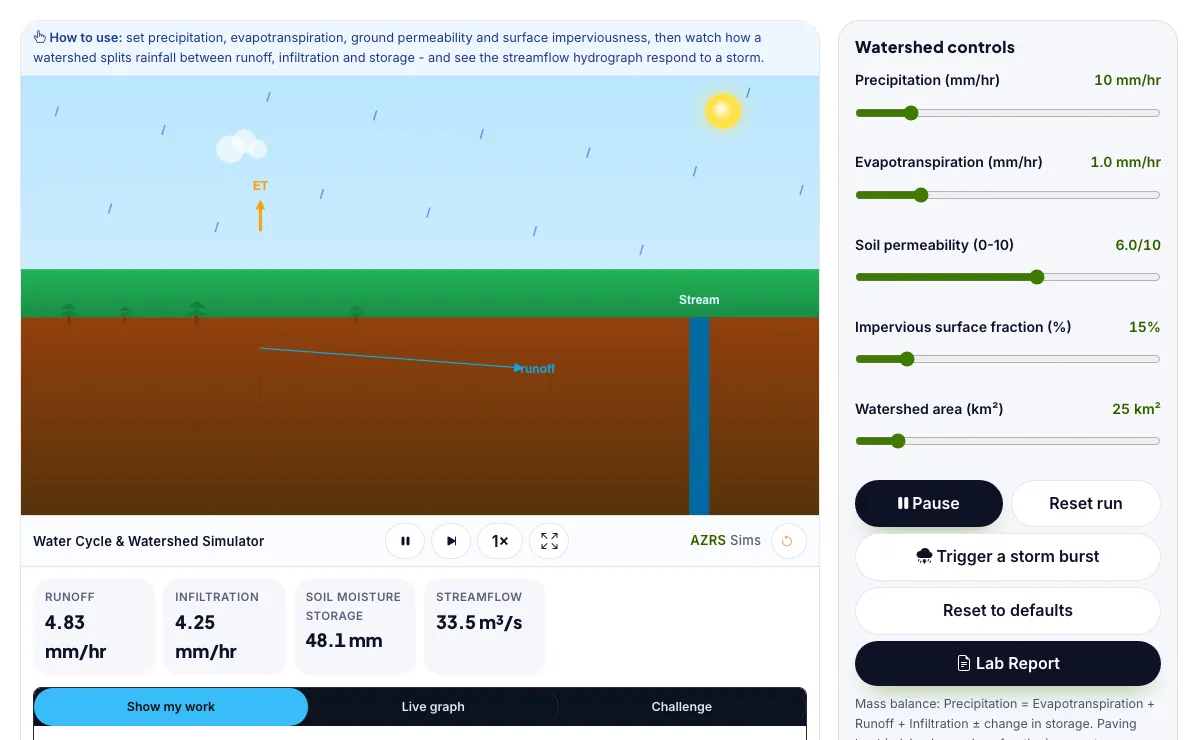
The Water Cycle & Watershed Simulator with sample data entered and the result showing.
What is the Water Cycle & Watershed Simulator?
Set rainfall, evapotranspiration and land cover and watch a real mass-balance model split water between runoff, infiltration and storage, with a live streamflow hydrograph. It runs in your browser, so a change to a setting or a drag on an object shows up at once.
Civil engineers size storm drains and floodplain maps using exactly this kind of runoff-versus-infiltration and hydrograph modeling, especially when urban development changes a watershed's impervious surface fraction.
3 steps to your result
Open the tool and follow along. Nothing to install.
What you get
The full water cycle mass balance is: Precipitation = Evapotranspiration + Runoff + Infiltration ± change in storage.
How much rain becomes runoff versus infiltration depends heavily on land cover: permeable soil and vegetation soak up much more water, while paved or compacted surfaces send nearly all of it straight to runoff.
Streamflow discharge equals the runoff depth multiplied by the watershed's drainage area, so the same storm produces far more streamflow over a large watershed than a small one.
Set impervious surface to 80% and rainfall to 40 mm/hr, then watch the hydrograph spike.
Compare the same rainfall on high permeability, 0% impervious land versus low permeability, 60% impervious land.
Try to balance precipitation against ET+runoff+infiltration exactly.
Used for
Pick one to see how it fits.
Environmental Science learners
Students, teachers and curious learners of all ages.
Try it freeTeachers
For teachers: project the Water Cycle & Watershed Simulator on the board, let students predict the result, then run it together and test this: Compare the same rainfall on high permeability, 0% impervious land versus low permeability, 60% impervious land. For students: change one thing at a time and write down what changes.
Try it freeHow it compares
A plain look at this tool next to the usual alternative.
| This simulation | Textbook diagram | |
|---|---|---|
| Interactive | Drag, tap and change settings | Fixed picture |
| Install | Nothing to install | Not needed |
| Cost | Free to use | Depends on the book |
Questions people ask
Why do cities flood more easily than forests in the same rainstorm?
Paved, impervious surfaces let almost all rainfall run off immediately instead of infiltrating into soil, so a city's watershed converts far more of a storm into fast runoff, producing a higher, faster streamflow peak than a forested watershed with the same rainfall.
If precipitation exceeds evapotranspiration, runoff and infiltration added together, where does the extra water go?
By mass balance it must be building up somewhere in the system as increased storage - as soil moisture, groundwater or a rising water table - which is exactly the ΔStorage term in the water balance equation.
Is the Water Cycle & Watershed Simulator free to use?
Yes. The Water Cycle & Watershed Simulator is free, needs no signup or download and runs in your web browser. It is part of the Environmental Science group of AZRS simulations.
Does the Water Cycle & Watershed Simulator work on a phone or tablet?
Yes. The Water Cycle & Watershed Simulator takes touch input as well as mouse input, so you can use its 5 adjustable settings with a finger. A larger screen makes the controls and graphs easier to read.
How do I use the Water Cycle & Watershed Simulator?
1. In the Water Cycle & Watershed Simulator, use the controls to change Precipitation (mm/hr), Evapotranspiration (mm/hr), Soil permeability (0-10), Impervious surface fraction (%), Watershed area (km²). The simulation reacts instantly. 2. In the Water Cycle & Watershed Simulator, press "▶ Run", "Reset run", "Trigger a storm burst" to start, reset or change what is happening. 3. Start with this experiment: Set impervious surface to 80% and rainfall to 40 mm/hr, then watch the hydrograph spike. Drag any glowing handle, object or slider with your mouse or finger and the Water Cycle & Watershed Simulator responds in real time. 4. Change one setting at a time and watch which readout moves, then compare it with this idea: The full water cycle mass balance is: Precipitation = Evapotranspiration + Runoff + Infiltration ± change in storage.
More free tools
Related to the Water Cycle & Watershed Simulator.
Try the Water Cycle & Watershed Simulator now
Set rainfall, evapotranspiration and land cover and watch a real mass-balance model split. Free to use.
Try it free