Halal Scanner
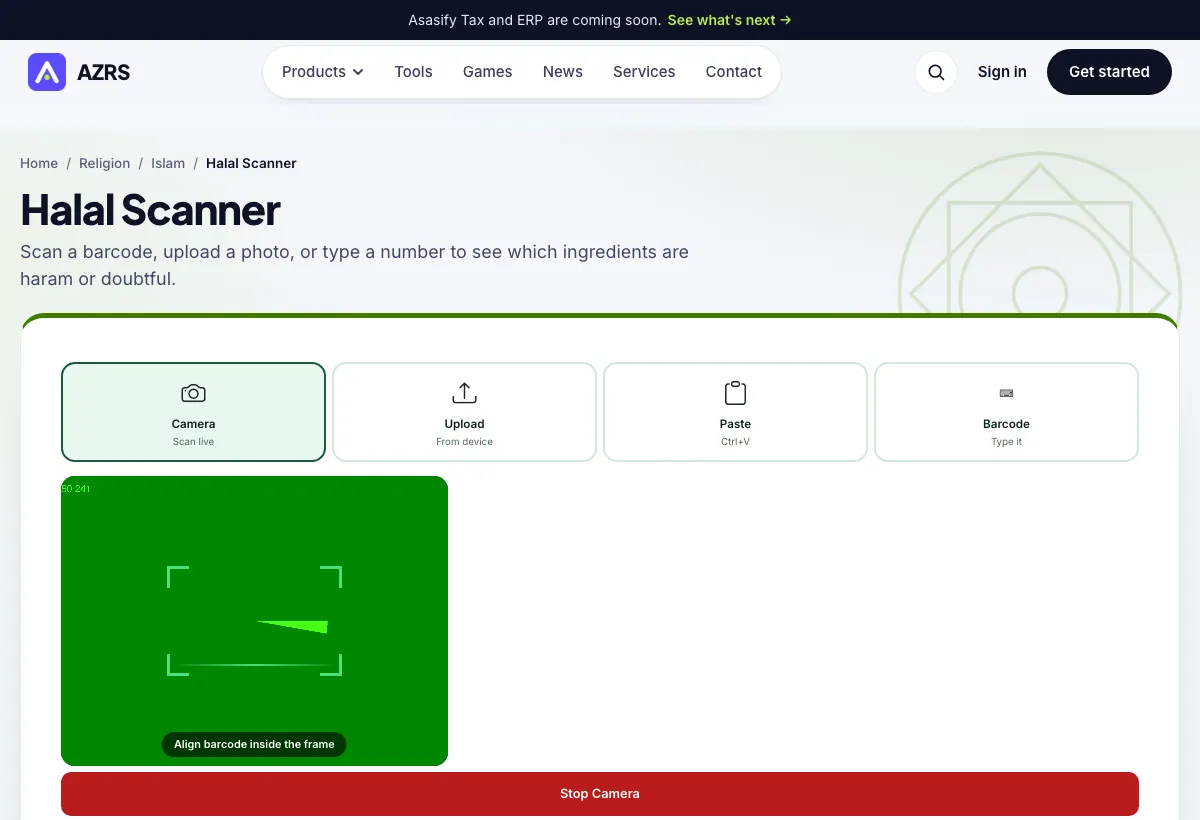
Scan a barcode, upload a photo, or type a number to see which ingredients are haram or doubtful.
Quick E-Number & Ingredient Checks
Haram and doubtful ingredients checked
Guidance only. Confirm any religious ruling with a qualified scholar or your local mosque.
About the Halal Scanner tool
This scanner reads a barcode with your camera, from a photo, or from the number you type. It looks the product up in public food databases and checks the ingredient list against a set of ingredients that are haram or doubtful, such as pork products, alcohol, blood, carmine and shellac.
If a product is not found, you can search by name or paste the ingredient list yourself. An AI helper can then give a plain summary. Ingredient labels can be incomplete, and a product may change its recipe, so the result should be treated as a guide.
Items marked doubtful, such as gelatin of unknown source, depend on where the ingredient comes from. For those, look for a halal certification from a body your community trusts, or ask a qualified scholar.
How to use it
Choose how to scan. Pick Camera, Upload, Paste or Barcode. Camera and Upload read the barcode from an image; Barcode lets you type it.
Run the check. Point the camera at the barcode or press Check. The tool searches the databases in turn.
Read the result. See the product, its ingredients and the checks for pork, alcohol, blood, carmine, shellac and gelatin.
If not found. Search by name, or paste the ingredient list and press Analyze to get a summary.
A barcode check
Product name and ingredient list found
Checks for pork, alcohol, blood and carmine shown
Doubtful items such as gelatin source flagged for follow up
Tips for good results
- Type the digits printed under the barcode if the camera struggles in low light.
- Check the label itself too; recipes change, and database entries can be out of date.
- Look for the name of the halal certifier, not only the word halal.
- Pay attention to the doubtful group and ask when the source is not stated.
Common mistakes
- Treating a "clear" result as a halal certification.
- Relying on a database entry without reading the packet.
- Ignoring doubtful ingredients with an unstated source.
- Scanning at an angle or in poor light and trusting a half-read code.
Common questions
Does a clear result mean the product is halal?
No. It means the scanner did not find a listed haram or doubtful ingredient. A halal certification or a scholar's view is still the stronger assurance.
What does doubtful mean?
An ingredient is doubtful when its source is not stated, such as gelatin, rennet or natural flavours. It can be halal or not depending on where it comes from.
Where do the product details come from?
From public food databases and, when needed, an AI helper. Entries can be incomplete or out of date.
Is the kosher note a halal ruling?
No. The note explains that kosher food is a different category. Questions about eating it should go to a qualified scholar.
Does the page keep my scans?
Recent scans are stored in your own browser so you can reopen them. You can clear them with the Clear all button.